Does Google Penalize AI Content? What It Really Punishes
No, Google does not penalize content because AI wrote it. It penalizes pages produced at scale to manipulate rankings, whoever or whatever wrote them. Here is the official position, where the line sits, and how I would use AI without risk.

Published · Updated · 11 min read
Contents
Does Google penalize AI content? No, not because it is AI. Google settled this in writing in February 2023: "Appropriate use of AI or automation is not against our guidelines", wrote Danny Sullivan and Chris Nelson on the Google Search Central blog. What Google does punish is something narrower and much more common: pages churned out in bulk to rank, with nothing in them a reader could not get elsewhere.
The question matters more every month. According to a Graphite study of 43,000 English-language articles sampled from Common Crawl, AI-generated articles started to outnumber human-written ones in November 2024. When half the web is written by machines, "written by AI" cannot be a ranking signal on its own. Quality has to be. I ran an SEO agency with more than 100 clients before building Sorank, and my view is simple: when a site loses traffic after going all-in on AI, the tool is rarely the cause. The strategy is: publish more, check less.
Does Google penalize AI-generated content?
No. Google judges the quality of a page, not how it was produced, and it has said so in its official documentation since 2023. AI content that is accurate, useful and original can rank like any other page. AI content that exists only to capture search traffic falls under the spam policies, exactly as low-effort human content does.
The February 2023 post is titled around one idea: "rewarding high-quality content, however it is produced". Google's guide on creating helpful, reliable, people-first content adds a simple test it calls "Who, How, and Why". The "how" can include "automated, AI-generated, and AI-assisted content". The "why" is the one that decides: "The 'why' should be that you're creating content primarily to help people."
The same page then draws the line: using automation, including AI generation, "to produce content for the primary purpose of manipulating search rankings" is "a violation of our spam policies". So the honest answer to the question is two sentences long. AI is a tool Google accepts. Using any tool to flood the index is what it fights.
What exactly does Google punish?
Google punishes scaled content abuse: many pages generated "for the primary purpose of manipulating search rankings and not helping users", in the words of its spam policies. The policy applies "no matter how it's created". AI is named as one way to do it, not as the problem.
The policy lists concrete examples. The first one is the one people worry about: "Using generative AI tools or other similar tools to generate many pages without adding value for users". The others are older tricks that AI just made cheaper:
- scraping feeds or search results to generate pages, including through "automated transformations like synonymizing, translating" or other obfuscation;
- stitching content from different pages together without adding value;
- creating several sites to hide the scaled nature of the content;
- creating pages that make little sense to a reader but contain search keywords.
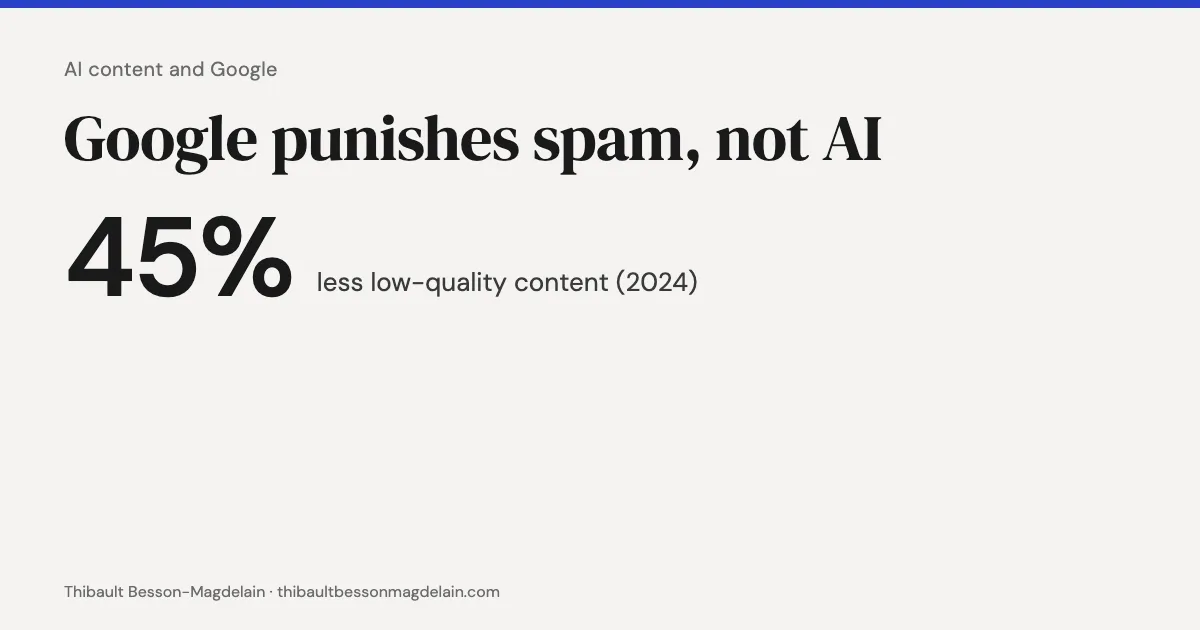
This policy is not theoretical. When Google announced it on 5 March 2024, Elizabeth Tucker, Director of Product Management, wrote that the update targeted "producing content at scale to boost search ranking, whether automation, humans or a combination are involved", and that the changes would reduce low-quality, unoriginal content in search results by 40%. A note added to the same post after the rollout reported a 45% reduction. That is the scale of the cleanup, and it hit human content farms as hard as AI ones.
The consequence can be a manual action (a human reviewer at Google flags the site, visible in Search Console) or an algorithmic demotion with no message at all. The second one is more common and harder to spot, because traffic simply erodes.
Which AI uses are safe and which are spam?
A use is safe when a human adds something the model could not (data, experience, verification) and when the number of pages matches real demand. It becomes risky when AI replaces judgment and the page count is driven by keywords, not by readers. The table below is how I sort the most common cases.
| AI use | Risk | Why |
|---|---|---|
| Outline, research, first draft rewritten by an expert | Low | Google's own guidance cites AI as useful for research and structure |
| Article built on your own data, checked line by line | Low | Original information, verified facts |
| Rewording titles and meta descriptions, then reviewing them | Low | Google asks you to review metadata too |
| Product descriptions generated for a shop | Medium | Fine if accurate; Google asks merchants to label AI-generated titles and descriptions |
| Machine translation published without review | Medium to high | Automated translation with little value is listed in the spam policy |
| Hundreds of "service + city" pages with swapped words | High | Many pages, no added value: textbook scaled content abuse |
| Rewriting competitors' articles with a paraphrasing tool | High | Scraping plus synonymizing, explicitly named by Google |
Google's guidance on using generative AI content is short and practical. Its strongest sentence is about accuracy: "It is critical to manually factcheck and review all AI-generated content for accuracy and trustworthiness before publishing." It also reminds you that titles, meta descriptions, structured data and image alt text are content too, and that AI-generated images on shopping sites need IPTC metadata (a standard label embedded in the image file that says it was made by an algorithm).
Can Google detect AI content?
It does not need to. Because the policy targets value and intent, not authorship, Google's systems look for what spam has in common: thin pages, duplication, sudden surges of near-identical URLs, no sign of first-hand knowledge. A perfect AI detector would not change the rule, and a page that fools every detector can still be demoted for being useless.
My opinion: stop worrying about detectors. The third-party "AI detectors" that SEO teams run on their drafts have known error rates; even Graphite, which used one for its study, measured a 4.2% false positive rate on articles published before ChatGPT existed. If a human-written page can be flagged as AI, then "passing the detector" proves nothing. Ask the question Google asks instead: would a reader who landed here from search be glad they did?
Does AI content get cited by ChatGPT and other AIs?
It can, but generic content rarely is. In the 498158 answers that Sorank collected from ChatGPT, Gemini, Perplexity, Claude and Grok between August 2025 and October 2026 (snapshot of 2 November 2026), the most cited sources are places that carry proof: Trustpilot (2.56 citations per 100 answers), service-public.gouv.fr (2.36) and Wikipedia (2.08). Reviews, official rules and a heavily edited encyclopedia.
| Rank | Website | What it brings | Citations per 100 answers |
|---|---|---|---|
| 1 | Trustpilot | Verified customer reviews | 2.56 |
| 2 | service-public.gouv.fr | Official rules (French government) | 2.36 |
| 3 | Wikipedia | Edited, sourced reference | 2.08 |
| 4 | economie.gouv.fr | Official rules (French government) | 1.82 |
| 5 | pagesjaunes.fr | Business listings | 1.78 |
The other side of the data is encouraging: those answers cite 184406 different domains. The long tail is open to any page that gives a clear, verifiable answer. The researchers behind the term GEO (optimization for generative engines) tested what makes a page more visible in AI answers, and found that adding statistics and quotations from sources helped most, while keyword stuffing did not. As they put it:
"GEO can boost visibility by up to 40% in generative engine responses."Aggarwal et al., GEO: Generative Engine Optimization, KDD 2024
Mass-produced AI text is, by construction, a summary of what already exists. It has no new statistic and nobody to quote. That is why I see AI as a writing assistant for content that carries your own proof, not as a content factory. If you want to see which pages AIs cite in your market, the analysis of which sources AI cites goes deeper, and how to rank in ChatGPT covers the method.
How do you use AI for SEO content without risk?
Use AI for speed on the parts that do not need judgment, and keep a human on everything that does: the angle, the facts, the examples and the final read. Publish only as many pages as you can check. Here is the workflow I recommend.
- Start from a real question. Pick a query people actually search, with a clear intent. One page per intent, not one page per keyword variant.
- Bring something the model does not have. Your numbers, a test, a client situation you can describe without naming anyone, a strong opinion. This is your information gain, the part Google cannot find elsewhere.
- Let AI do the heavy lifting. Outline, first draft, reformulations, a table from your data. It saves hours, and Google is fine with it.
- Check every fact. Every figure needs a source you opened yourself; every quote must exist. Models invent references with confidence.
- Edit for a human voice. Cut the generic intro, the "in today's fast-paced world", the conclusion that repeats the intro. Add the author's name and real credentials.
- Review the metadata. Title, description, alt text, structured data, as Google's guidance asks.
- Measure after publishing. Positions in Google and mentions in AI answers, page by page. A page that never ranks after three months should be improved or merged, not left to dilute the site.
Tools can speed up steps 3 and 7. Sorank's article generator (it is my tool, so read this with that in mind) drafts from your brand voice, and the AI mention tracking tells you whether ChatGPT, Gemini and the others cite the result. Steps 2, 4 and 5 stay human. If you want to check the rest of your site first, the SEO audit checklist is a good starting point.
What if your AI pages already lost traffic?
Treat it as a quality problem, not an AI problem: find the pages with no value, then improve, merge or remove them. Rewriting them with a different AI prompt changes nothing if they still answer nothing new.
- Check Search Console first. Look under "Manual actions". If there is one, the message tells you the policy; fix it site-wide, then file a reconsideration request.
- No manual action? Compare clicks before and after the drop, and list the pages that lost the most. Bulk-generated pages usually lose together.
- Sort every weak page into three piles. Worth improving (real demand, can add proof), worth merging (overlaps another page), worth removing (no demand, no value). Redirect merged pages.
- Be patient. Google has to recrawl and reassess the pages you changed. Count in weeks or months, not days.
So, does Google penalize AI content?
Google does not penalize content for being written by AI; it penalizes pages produced at scale to manipulate rankings, with little value for readers, whether a model or a person wrote them. Use AI to write faster, keep a human on facts and judgment, publish what you can stand behind, and measure what ranks and what AIs cite.
To see whether your pages hold up in Google and in ChatGPT, Gemini, Claude, Perplexity and Grok, compare Sorank's plans.
Sources
- Google Search Central blog, "Google Search's guidance about AI-generated content", 8 February 2023: AI use is not against the guidelines.
- Google Search Central, "Spam policies for Google web search": definition and examples of scaled content abuse.
- Google Search Central, "Guidance on using generative AI content on your website": fact-checking, metadata, e-commerce rules.
- Google Search Central, "Creating helpful, reliable, people-first content": the Who, How and Why test.
- Google blog, Elizabeth Tucker, 5 March 2024: 40% target, 45% reduction after rollout.
- Graphite, "More articles are now created by AI than humans": 43,000 articles, crossover in November 2024.
- Aggarwal et al., "GEO: Generative Engine Optimization", KDD 2024: up to 40% visibility gain.
- Sorank Data, snapshot of 2 November 2026: citation figures from 498158 AI answers.
FAQ
Is it OK to use ChatGPT to write blog posts for SEO?
Yes, as long as the post is accurate, useful and checked by a human. Google says appropriate use of AI is not against its guidelines. What it fights is publishing many pages with no added value to manipulate rankings, whatever tool made them.
Does Google tell you if it penalized your AI content?
Only for manual actions, which appear in the "Manual actions" report of Search Console. Algorithmic demotions send no message: you see them as a drop in clicks and positions, often on a whole group of similar pages at once.
Should I disclose that I used AI?
Google says disclosures about how content was made are useful when readers would reasonably ask the question, for example for automated content. For product listings, Google asks merchants to label AI-generated titles and descriptions. A clear author line with real credentials matters more than a generic AI notice.
Founder of Sorank, the SEO and GEO platform that tracks how ChatGPT, Gemini, Perplexity, Claude and Grok talk about brands. Before Sorank, I ran an SEO agency that served more than 100 clients. Based in Budapest.
Read next
-
SaaS SEO: Build the Pages That Sell Before the Blog
SEO for software companies: comparison, alternatives, integration and pricing pages before the blog, with AI data.
-
Core Web Vitals: Thresholds, Real Ranking Weight and Fixes
LCP, INP and CLS thresholds, their real ranking weight, and the fixes to do first.
-
Free Keyword Research: How to Find the Right Keywords Without Paid Tools
Free keyword research with Search Console, autocomplete, Google Trends and AI prompts, turned into a keyword map.
Continue on SEO and AI visibility: all articles on the blog