How to Rank in ChatGPT: 7 Steps Backed by Real Data
ChatGPT recommends the companies that several trusted sources agree on. Here is how it picks them, what it cites, and the seven steps I would follow to get a brand into its answers.

Published · Updated · 10 min read
Contents
- How does ChatGPT decide which brands to recommend?
- Which sources does ChatGPT cite when it recommends a business?
- Is ranking in ChatGPT different from Gemini or Perplexity?
- How do you rank in ChatGPT, step by step?
- How long does it take to appear in ChatGPT?
- Can you pay to appear in ChatGPT answers?
- What are the common mistakes?
- FAQ
How to rank in ChatGPT is now a real business question, not a curiosity. When a buyer asks ChatGPT for "the best accountant for a small company" or "a CRM for a 10 person team", it answers with a short list of names, and the companies outside that list simply do not exist for that buyer. Usage is already mainstream: 34% of US adults had used ChatGPT by early 2025, according to Pew Research Center, about double the share of 2023.
There is no ranking factor list published by OpenAI, so most guides you will read are guesses. I prefer data. Sorank asks the same buyer questions to five AIs every week, and the public dataset (sorank.com/data, snapshot of 2 November 2026) holds 498,158 answers, of which 148,295 come from ChatGPT. This guide uses those numbers and OpenAI's own documentation to give you a step by step method that I would follow on any website.
How does ChatGPT decide which brands to recommend?
ChatGPT recommends brands from two places: what the model learned during training, and what it finds when it searches the web for the question. For buyer questions, the search part matters most, because that is where the links come from and where recent information enters. Your job is to be findable by that search and to be confirmed by the sources it reads.
The search part has a name and a door. OpenAI documents a crawler called OAI-SearchBot, and its documentation is blunt about it:
"Sites that are opted out of OAI-SearchBot will not be shown in ChatGPT search answers."OpenAI, Overview of OpenAI crawlers
The same page explains that GPTBot is a separate crawler used for training, and that ChatGPT-User only visits pages when a user action asks for it. In plain words: blocking GPTBot keeps your content out of future training, blocking OAI-SearchBot keeps you out of ChatGPT search. Many sites block both by accident through a blanket rule. I cover the details in my guide to robots.txt for AI crawlers.
Once ChatGPT has its search results, it picks the companies that several sources agree on. That is why your own homepage is rarely the link it shows: it shows the pages that vouch for you.
Which sources does ChatGPT cite when it recommends a business?
On business questions, ChatGPT leans on official and reference websites far more than the other AIs. Its top three domains in the Sorank data are service-public.gouv.fr (5.98 citations per 100 answers), Wikipedia (5.38) and economie.gouv.fr (4.30). Review platforms come next, with Trustpilot at 1.89.
The panel is mostly French (128,224 of the ChatGPT answers are about French speaking markets), which explains the French government sites. The pattern is what matters: ChatGPT wants a reference that frames the decision (rules, definitions, official lists), then a few signals about the companies themselves. If your market has a regulator, a professional body or an official registry, being listed there correctly is step zero.
In English, the shape is the same with local institutions. ChatGPT's top English sources are ftc.gov (4.27 citations per 100 answers), Amazon (4.12), Wikipedia (2.27), Trustpilot (2.18) and the US National Institutes of Health office of dietary supplements (2.12), on 19,021 English ChatGPT answers. I go deeper into these lists in where ChatGPT gets its sources and in the full study which sources AI cites.
Is ranking in ChatGPT different from ranking in Gemini or Perplexity?
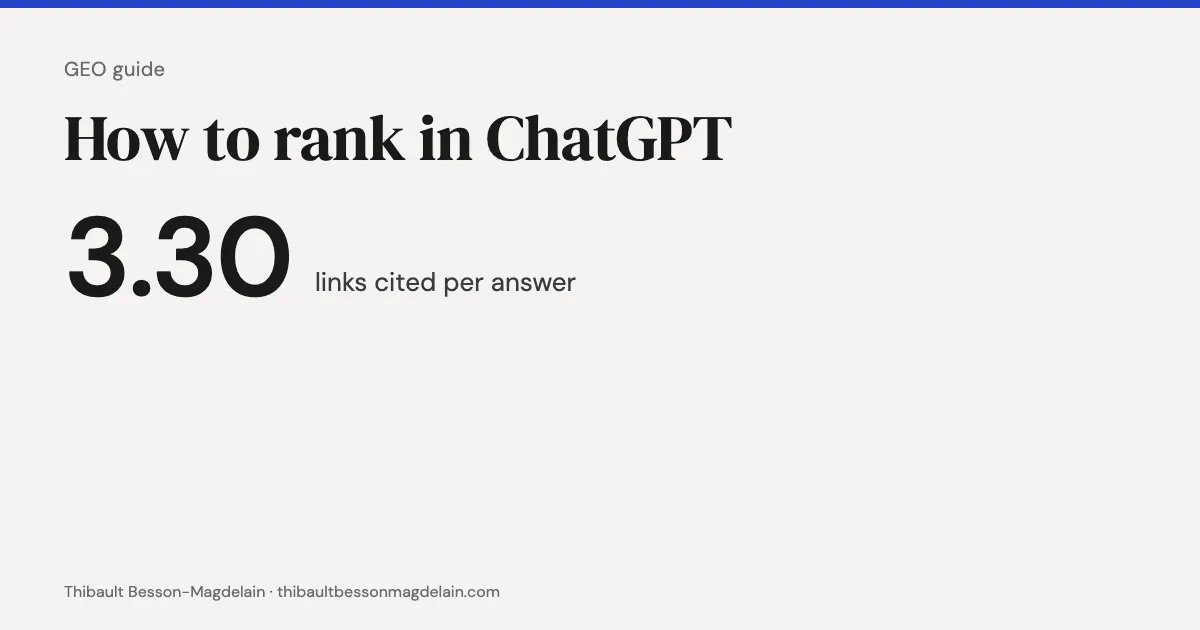
Yes. ChatGPT gives fewer links than Gemini and picks them from a narrower set. On average it cites 3.30 links per answer, against 9.21 for Gemini and 6.72 for Grok. Fewer links means fewer seats at the table: each source ChatGPT keeps carries more weight.
| Source | ChatGPT | Gemini | Perplexity | Claude |
|---|---|---|---|---|
| Wikipedia | 5.40 | 1.49 | 0.12 | 0.13 |
| Trustpilot | 1.83 | 3.93 | 1.08 | 0.80 |
| YouTube | 0.06 | 4.01 | 2.30 | 0.03 |
| 0.14 | 1.47 | 0.79 | 0.00 | |
| 0.42 | 1.01 | 0.73 | 0.16 |
Read the first column carefully. A YouTube strategy does almost nothing for ChatGPT (0.06 citations per 100 answers), while it is one of Gemini's top sources. Reddit, often sold as the key to AI visibility, gets 0.14 in ChatGPT. Wikipedia, on the other hand, is ChatGPT's second source. My opinion: if ChatGPT is the AI your buyers use, spend your effort on reference sources and reviews, not on video or forums.
How do you rank in ChatGPT, step by step?
Open the door to OpenAI's search crawler, find the sources ChatGPT trusts in your market, be present and accurate on them, make your own pages easy to quote, and measure every month. Here is the order I follow, from the fastest fix to the slowest.
- Allow OAI-SearchBot. Open yoursite.com/robots.txt. If you see "User-agent: OAI-SearchBot" followed by "Disallow: /", or a "User-agent: *" block that disallows everything, ChatGPT search cannot show you. OpenAI says changes take about 24 hours to be picked up. Also check your firewall or CDN: some block AI crawlers by default.
- Write your buyer questions. Ten to thirty questions your customers really ask before buying: "best X for Y", "X vs Y", "is X reliable", "X near me". Never your brand name alone, because ChatGPT will name you when asked about you. The test is whether it names you when asked about the problem.
- List the sources ChatGPT uses for those questions. Ask each question with search turned on, in a fresh chat, and note every domain in the links. After 20 to 30 answers, the same five or six domains come back. Those are your targets.
- Be present and accurate there. A complete profile on the review platform and directories that appear, with real and recent reviews. An entry in the official register of your profession if one exists. A Wikipedia article only if you meet its notability rules: a promotional page gets deleted and can hurt you.
- Make your pages easy to quote. Put a direct answer in the first lines of each page, state facts about your company plainly (what you sell, where, for whom, since when, at what price range), and back numbers with a source. The Princeton researchers who named GEO (generative engine optimization) measured the effect of this kind of change: "GEO can boost visibility by up to 40% in generative engine responses" (Aggarwal et al., KDD 2024).
- Earn mentions in comparison content. ChatGPT recommends what several sources agree on. Being named in independent comparisons, industry lists, local press or partner pages gives it that agreement. A single mention on your own site does not.
- Measure every month. Same questions, same settings, and log two things: the companies named and the domains cited. A free ChatGPT visibility check is a good first look; the full method is in my guide to tracking AI rankings.
How long does it take to appear in ChatGPT?
The technical fix is fast, the reputation work is not. A robots.txt change is picked up in about 24 hours according to OpenAI. Profiles and reviews on third-party sites show up as soon as ChatGPT search reads them again, which can be days or weeks. What the model learned in training only changes when a new model is released, and you do not control that calendar.
Expect your answers to move a lot along the way. In the Sorank data, ChatGPT's favorite sources shift from month to month: Wikipedia across all AIs went from 11.31 citations per 100 answers in October 2025 to 0.12 in October 2026. Part of that is the panel growing (from 1,185 ChatGPT answers in October 2025 to 33,829 in October 2026, so the early months are indicative only), part is the models. Either way, judge progress on a three month trend, not on one screenshot.
Can you pay to appear in ChatGPT answers?
No, not in the answer itself. OpenAI started testing ads in the US in February 2026 for Free and Go users, and stated that "Ads do not influence the answers ChatGPT gives you" (TechCrunch, 9 February 2026). Ads are labeled as sponsored and placed apart from the response.
So an ad can put your name next to an answer, but it will not make ChatGPT recommend you. Be careful with any agency that promises "guaranteed placement in ChatGPT": nobody can guarantee what a model says, and the answers vary from one session to the next.
What are the common mistakes that keep brands out of ChatGPT?
The most common mistake is invisible: a robots.txt or firewall rule that blocks OAI-SearchBot. The others are about evidence. Here are the ones I see most often when I audit a site.
- Testing with the brand name. "What is Acme?" proves nothing. Test the problem, not the name.
- Only working on your own site. ChatGPT cites what others say about you. Ten new blog posts weigh less than one complete, well reviewed profile on the platform it trusts.
- Inconsistent facts. A different address, price or service list on each directory makes it harder for the model to confirm who you are.
- Content hidden behind JavaScript. If your key facts only appear after scripts run, a crawler may see an empty page. Check the raw HTML.
- One test, one conclusion. ChatGPT answers vary. Ask each question several times and count how often you appear, not where you appeared once.
If ChatGPT already says something wrong about your company, that is a different problem; I explain how to handle it in what to do when ChatGPT talks about your brand.
So, how do you rank in ChatGPT?
You rank in ChatGPT by letting OAI-SearchBot read your site, then by being present, accurate and well reviewed on the reference sources ChatGPT already trusts in your market, and by measuring it every month. The data shows ChatGPT cites few links (3.30 per answer) and favors official sites, Wikipedia and review platforms, so each of those sources weighs a lot. There is no paid shortcut and no guaranteed position, only evidence that several sources agree on.
The first step takes five minutes: ask ChatGPT your top three buyer questions today and see who it names. To do it every week across your whole list, track your ChatGPT rankings with Sorank (plans on the pricing page).
Sources
- Sorank Data, AI citation study, snapshot of 2 November 2026: every citation figure in this article.
- OpenAI, "Overview of OpenAI crawlers": OAI-SearchBot, GPTBot, ChatGPT-User and the 24 hour delay.
- Aggarwal et al., "GEO: Generative Engine Optimization", KDD 2024: the up to 40% visibility gain.
- Pew Research Center, 25 June 2025: 34% of US adults have used ChatGPT.
- TechCrunch, 9 February 2026: ChatGPT ads test and OpenAI's statement that ads do not influence answers.
FAQ
Can you pay to be recommended by ChatGPT?
No. ChatGPT ads, tested in the US since February 2026, appear apart from the answer and are labeled as sponsored. OpenAI states that ads do not influence the answers. To be recommended, you need to be confirmed by the sources ChatGPT reads.
How long does it take to show up in ChatGPT?
A robots.txt fix that unblocks OAI-SearchBot is picked up in about 24 hours according to OpenAI. New profiles, reviews and mentions on third-party sites take days to weeks to be read again. What the model learned in training only changes with a new model.
Why is ChatGPT not recommending my business?
The usual causes are a robots.txt or firewall rule blocking OAI-SearchBot, no presence on the reference sites ChatGPT cites in your market (official registers, Wikipedia, review platforms), inconsistent facts across directories, and key information hidden behind JavaScript.
Founder of Sorank, the SEO and GEO platform that tracks how ChatGPT, Gemini, Perplexity, Claude and Grok talk about brands. Before Sorank, I ran an SEO agency that served more than 100 clients. Based in Budapest.
Read next
-
AI Rank Tracker: How AI Rank Tracking Works and What to Look For
How AI rank tracking works: prompt panels, mention and citation rates, sample sizes, per-model results and what to demand from a tool.
-
llms.txt: What It Is, Who Reads It, and Is It Worth It?
What llms.txt is, who actually reads it according to the evidence, whether it is worth it, and an example file to copy.
-
GEO vs SEO: What Changes, What Stays the Same, and What to Do
GEO vs SEO point by point: the shared foundation, what changes with AI answers, and how to split your effort between the two.
Continue on AI visibility: all articles on the blog