llms.txt: What It Is, Who Reads It, and Is It Worth It?
llms.txt is the most talked about file in AI search, and the least proven. Here is what it is, what the evidence says about who reads it, and an example you can adapt in ten minutes.

Published · Updated · 10 min read
Contents
llms.txt is a Markdown file placed at the root of a website to give AI systems a short summary of the site and a list of its most useful pages. It was proposed by Jeremy Howard on 3 September 2024 as "a proposal to standardise on using an /llms.txt file to provide information to help agents use a website". Two years later, it is everywhere in SEO checklists, and almost nobody can say who actually reads it.
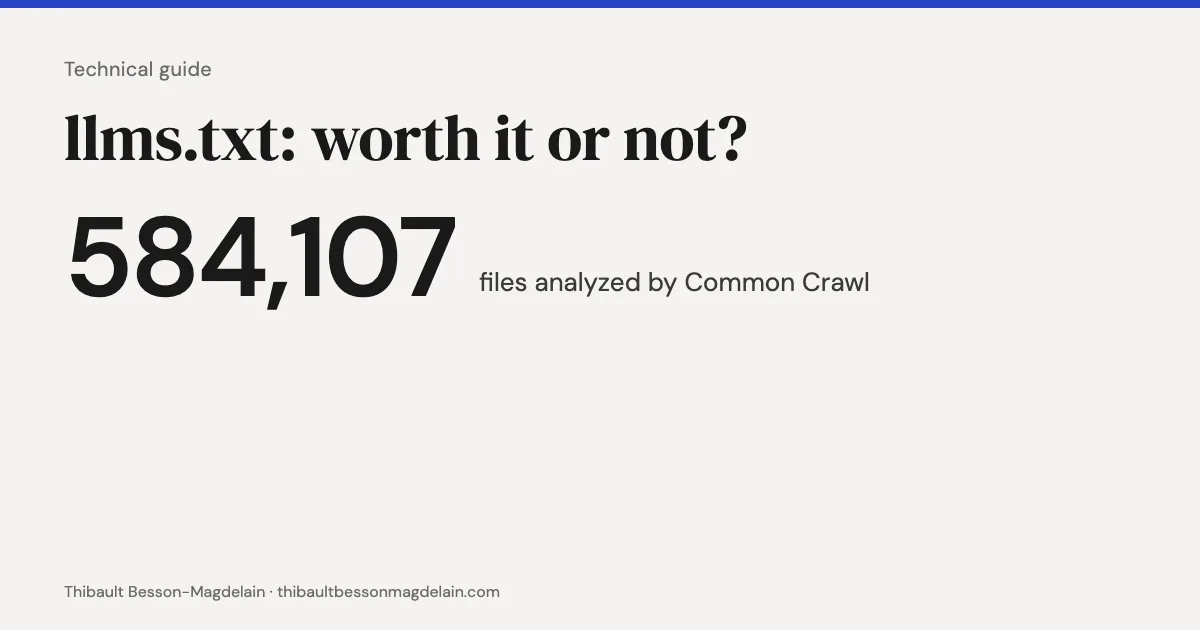
I wanted a clear answer for my own sites and for the people who ask me every week whether they "need an llms.txt to appear in ChatGPT". So I went to the primary sources: the proposal itself, Google's documentation, the crawler documentation of OpenAI, and the largest independent measurement I know of, Common Crawl's analysis of 584,107 llms.txt files. Here is what the evidence says, what I recommend, and a ready to adapt example file.
What is llms.txt?
llms.txt is a plain Markdown file at yoursite.com/llms.txt that describes your site in a few lines and links to the pages an AI should read first. It is a proposal, not a standard ratified by any standards body, and no AI company is obliged to read it. Think of it as a table of contents written for machines.
The idea makes sense on paper. A web page is full of menus, scripts and cookie banners; a language model has a limited context window. A short, clean Markdown file with the essentials and links to Markdown versions of your key pages is cheaper to read than your whole HTML. That is why the format took off first on developer documentation sites: Anthropic publishes one at docs.claude.com/llms.txt, OpenAI at developers.openai.com/llms.txt, Stripe at docs.stripe.com/llms.txt. Coding assistants that fetch documentation on demand are the clearest use case.
What does an llms.txt file contain?
Only one line is required: an H1 title with the name of the site. The proposal then recommends a blockquote summary, optional free text, and H2 sections made of Markdown links with a short note after each one. A section titled "Optional" holds links an agent can skip when it needs a shorter context.
The proposal also asks sites to publish clean Markdown versions of useful pages at the same address with ".md" added (page.html.md or page.md). A related file, llms-full.txt, is used by some documentation sites to put the full text of all pages in one file; it is a convention that grew around the proposal, not part of its core. The Sorank glossary entry on llms.txt sums up the vocabulary if you need it.
Do ChatGPT, Google, Claude or Perplexity actually read llms.txt?
There is no public evidence that a major AI search product uses llms.txt to choose what to cite. Google says plainly that you do not need it, and its Search Advocate John Mueller wrote in June 2025 that no AI system used it. OpenAI's crawler documentation describes robots.txt controls, not llms.txt. AI companies publish llms.txt files for their own docs, which is not the same as reading yours.
Google's position is the most explicit. Its documentation on AI features states: "You don't need to create new machine readable files, AI text files, or markup to appear in these features" (Google Search Central). And John Mueller put it in one line:
"FWIW no AI system currently uses llms.txt."John Mueller, Google Search Advocate, Bluesky, 17 June 2025
| Who | What they say or do | What it means for you |
|---|---|---|
| Google (Search, AI Overviews, AI Mode) | Says no AI text file is needed; Mueller: "no AI system currently uses llms.txt" | No effect on Google rankings or AI Overviews |
| OpenAI (ChatGPT) | Crawler docs explain robots.txt rules for OAI-SearchBot and GPTBot; publishes its own llms.txt for developer docs | robots.txt decides if you can appear; llms.txt is not documented as a signal |
| Anthropic (Claude) | Publishes llms.txt for its developer docs | Shows the format is useful for documentation, not for rankings |
| Coding assistants and agents | Can fetch llms.txt when a user points them to a site or a library | The one real use case today |
| Common Crawl | Crawled and analyzed 584,107 files in July 2026 | Files exist at scale; half do not follow the format |
My reading: the file is read on demand (when an agent or a developer tool is sent to your site), not at scale by the crawlers that feed AI search. That distinction is the whole debate.
What does the data say about llms.txt adoption?
The most solid independent measurement comes from Common Crawl, the non-profit that publishes an open archive of the web. In its July 2026 crawl, it asked 5,167,831 random hosts for /llms.txt: only 19.61% of the requests returned a page, and 584,107 real files were analyzed. Half of them (49.90%) follow the full structure of the proposal.
The details are telling. About 68% of the files come from generators or templates, and Wix alone produces 41.34% of them: many site owners have an llms.txt they never wrote. 22.56% contain no link at all, which defeats the purpose of the format. And 6.59% try to use the file for rules it was never designed for, such as rate limits or opt-outs. The Common Crawl author is blunt about that last group: "Publishers writing opt-outs there have not opted out." If you want to block an AI crawler, it has to be in robots.txt (see my guide to robots.txt for AI crawlers).
Now compare with what AIs cite. In Sorank's study of 498,158 AI answers (snapshot of 2 November 2026), the most cited domains on business questions are Trustpilot (2.56 citations per 100 answers), service-public.gouv.fr (2.36) and Wikipedia (2.08). AIs recommend a company because third-party sources vouch for it. An llms.txt only describes your own site, so at best it helps an AI read you more cleanly; it does not create the outside evidence that gets you recommended. More on that in which sources AI cites.
Is llms.txt worth doing?
Yes, if it takes you less than an hour, and no, if you expect traffic from it. It costs almost nothing, it cannot hurt when done right, and it is useful for documentation and agent use. It is not a ranking factor in Google and there is no evidence it changes what ChatGPT or Perplexity cite.
- Do it first if you publish technical documentation, an API or a software product that developers use with coding assistants. That is where the file is actually fetched.
- Do it as a ten minute task if you run a business site. It is a clean summary of who you are, and it forces you to write the facts an AI needs (what, where, for whom, since when) in one place, which is useful on your homepage too.
- Do not do it instead of fixing robots.txt, server-side rendering, structured data or your presence on review platforms. Those have documented effects; llms.txt does not.
My opinion, after reading the evidence: llms.txt is a good idea that arrived before its readers. I keep one where it is cheap, I never sell it as a visibility lever, and I would be wary of anyone who does.
What does a good llms.txt look like?
A good llms.txt is short, factual and points to pages that answer real questions. Here is an example for a fictional accounting firm. Replace the facts with yours and keep each note to one line.
# Example Accounting

> Example Accounting is a chartered accounting firm in Lyon, France, founded in 2012. It serves freelancers and companies with fewer than 50 employees: bookkeeping, annual accounts, payroll and tax returns.

Prices are listed on the pricing page. We do not serve individuals for personal income tax.

## Services

- [Accounting for freelancers](https://example.com/freelancers.md): monthly bookkeeping and annual accounts
- [Payroll](https://example.com/payroll.md): payslips and social declarations for 1 to 50 employees
- [Pricing](https://example.com/pricing.md): fixed monthly fees by company size

## About

- [Team and credentials](https://example.com/team.md): partners, registration with the professional body
- [Reviews](https://example.com/reviews.md): where to read client reviews

## Optional

- [Blog](https://example.com/blog.md): guides on French tax deadlines
Three rules I apply when I write one:
- Facts, not slogans. "Chartered accounting firm in Lyon since 2012" is useful to a model. "Your trusted partner for growth" is noise.
- Say what you do not do. A line like "we do not serve individuals" helps an AI avoid recommending you for the wrong question.
- Link to pages that exist and stay. If you do not publish .md versions, link to the normal HTML pages; a broken link is worse than no link.
How do you create and check an llms.txt file?
Write the file in any text editor, save it as llms.txt in UTF-8, and upload it to the root of your domain so it answers at yoursite.com/llms.txt. Then check that it returns a 200 status with a text content type and that every link works.
- Draft it by hand from the template above, or start from a free llms.txt generator and edit the result.
- Upload it at the root. On WordPress, a plugin or your host's file manager does the job; on Wix and some other builders, a file may already exist, so read it before replacing it.
- Validate it: H1 present, blockquote summary, links in Markdown format, no broken URL. A llms.txt validator checks the structure in seconds.
- Keep it out of search results if you want: Mueller suggested in 2025 that a noindex header can make sense, since the file is not meant for human visitors.
- Do not put rules in it. Opt-outs, licences or rate limits belong in robots.txt, your terms, or your server configuration.
Then move on to the work that actually changes AI answers: being readable (see structured data for AI) and being cited by others (see my LLM SEO guide).
So, should you use llms.txt?
llms.txt is a useful summary file for AI agents and documentation tools, but no major AI search product has shown that it uses it to rank or cite websites, and Google says you do not need it. Common Crawl found 584,107 files in July 2026, half of them incomplete and two thirds generated by templates. Create one if it takes you an hour, write it with facts, and spend the rest of your effort where AIs actually look: robots.txt access, clean pages and third-party sources.
To see whether those efforts change what AIs say about you, track your AI mentions with Sorank (plans on the pricing page).
Sources
- llmstxt.org, "The /llms.txt file", Jeremy Howard: the proposal and its format.
- Google Search Central, "AI features and your website": no AI text files needed.
- John Mueller on Bluesky, 17 June 2025: "no AI system currently uses llms.txt".
- Common Crawl, content analysis of llms.txt files, 31 August 2026: 584,107 files analyzed.
- OpenAI, "Overview of OpenAI crawlers": robots.txt controls for OpenAI bots.
- Sorank Data, snapshot of 2 November 2026: most cited domains in 498,158 AI answers.
FAQ
Is llms.txt a Google ranking factor?
No. Google states that you do not need to create new machine readable files or AI text files to appear in AI Overviews or AI Mode, and its Search Advocate John Mueller wrote in June 2025 that no AI system used llms.txt. It has no documented effect on Google rankings.
What is the difference between llms.txt and robots.txt?
robots.txt is a recognized standard that tells crawlers what they may or may not fetch, and AI companies like OpenAI document that they follow it. llms.txt is a proposal that summarizes your site for AI agents; it cannot block anything. Put access rules in robots.txt only.
Does ChatGPT read llms.txt?
OpenAI does not document that its crawlers read llms.txt on other websites. Its crawler documentation is about robots.txt rules for OAI-SearchBot and GPTBot. ChatGPT may read the file if a user sends it to that URL, like any other page.
Founder of Sorank, the SEO and GEO platform that tracks how ChatGPT, Gemini, Perplexity, Claude and Grok talk about brands. Before Sorank, I ran an SEO agency that served more than 100 clients. Based in Budapest.
Read next
-
How to Rank in ChatGPT: 7 Steps Backed by Real Data
How ChatGPT picks the brands it recommends, what it cites, and the 7 steps to get into its answers.
-
Google AI Overviews SEO: How to Get Cited and Keep Clicks
How Google AI Overviews choose their sources, what they do to clicks, and how to become the cited page.
-
AI Rank Tracker: How AI Rank Tracking Works and What to Look For
How AI rank tracking works: prompt panels, mention and citation rates, sample sizes, per-model results and what to demand from a tool.
Continue on AI visibility: all articles on the blog