Google AI Overviews SEO: How to Get Cited and Keep Clicks
AI Overviews pick their links from Google's normal index, through a fan-out of sub-searches. Here is how they choose, what they do to clicks, and the steps I would take to be the cited source.

Published · Updated · 10 min read
Contents
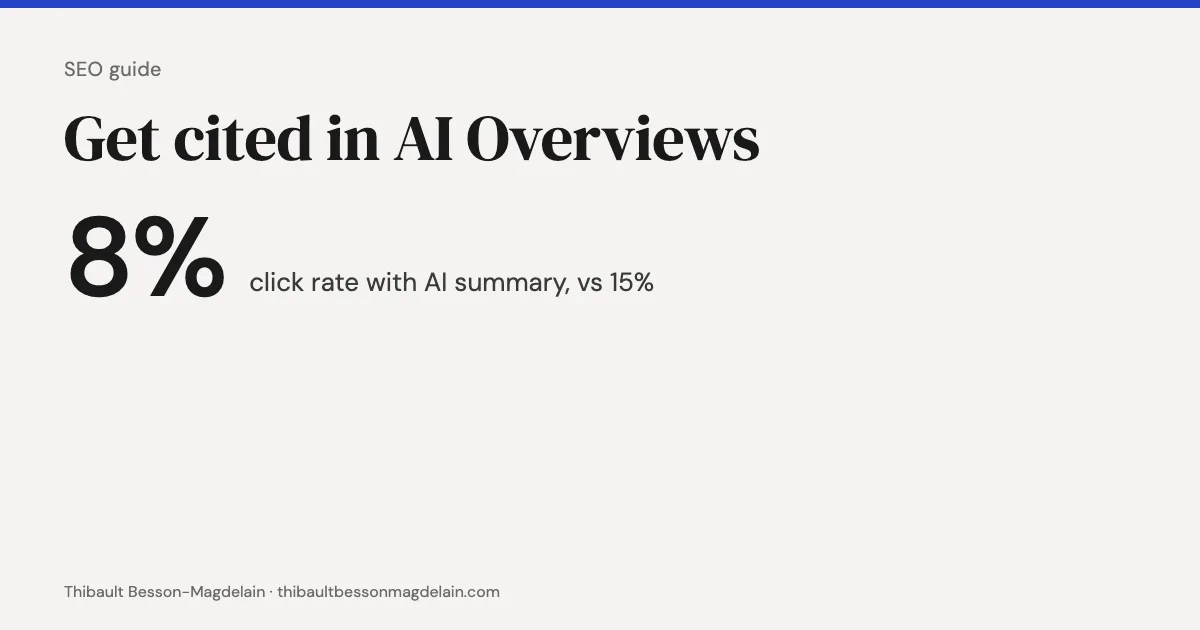
Google AI Overviews SEO is about one question: when Google writes an AI answer at the top of the results, is your page one of the links it shows? The stakes are large. Google's CEO Sundar Pichai said at I/O in May 2026 that "AI Overviews now has over 2.5 billion monthly active users". And the feature changes how people click: a Pew Research Center study found that users clicked a traditional result in 8% of visits with an AI summary, against 15% without one.
I have spent my career on Google SEO, first running an agency with more than 100 clients, now building Sorank, which tracks how AIs cite brands. Here is how AI Overviews pick their sources according to Google's own documentation, what the click studies really say, which sources Google's AI model tends to cite in the Sorank data, and what I would do on a site today.
What are Google AI Overviews?
AI Overviews are AI generated summaries shown at the top of some Google results, with links to the pages used to build them. They appear when Google's systems judge that a summary adds value over classic results, mostly on longer, question-like searches. They run on Google's Gemini family of models and sit next to AI Mode, the full conversational search.
They are no longer a US experiment. AI Overviews and AI Mode launched in France on 22 July 2026, after a long delay linked to press neighboring rights, and AI Overviews already covered more than 200 countries and territories and 40 languages by July 2025. If your market is in Europe, you are now in the same game as US sites.
How do AI Overviews choose their sources?
AI Overviews pick their sources from Google's normal search index. To be eligible as a supporting link, a page must be indexed and eligible to be shown in Google Search with a snippet. There is no separate AI index, no special markup and no file to add. Google says it in one sentence:
"There are no additional requirements to appear in AI Overviews or AI Mode, nor other special optimizations necessary."Google Search Central, AI features and your website
The mechanism behind the scenes is called query fan-out: Google says both AI Overviews and AI Mode may issue multiple related searches across subtopics and data sources, then pick supporting pages while the answer is written. That is why an AI Overview can link to pages that do not rank on page one for the original query: they rank for one of the sub-questions. I explain fan-out in detail in my guide to Google AI Mode SEO.
In practice, three things decide whether you are picked:
- Eligibility. Indexed, crawlable by Googlebot, no nosnippet tag, content visible in the HTML.
- Relevance to a sub-question. A passage that answers one precise part of the question clearly, in a few sentences, is easy to lift.
- Trust. The same signals as classic SEO: links, reputation, accuracy. Google does not publish a separate trust model for AI Overviews.
Do AI Overviews reduce clicks to websites?
Yes, on average. Pew Research Center tracked the browsing of 900 US adults in March 2025: users clicked a traditional result in 8% of visits with an AI summary, against 15% without. They clicked a link inside the summary in only 1% of visits, and ended their browsing session more often (26% against 16%).
Google's answer is that the clicks that remain are better. Its documentation states that "when people click from search results pages with AI Overviews, these clicks are higher quality", meaning visitors spend more time on the site. Both can be true: fewer clicks, more qualified ones.
My take: stop measuring AI Overviews only in traffic. On informational queries, the summary will answer many people without a click, whatever you do. What you can still win is being the cited source, which keeps your brand in front of the reader and brings the visitors who want more. That changes which pages you invest in: definitions and quick answers lose traffic, comparisons, tools and local or commercial pages keep it.
Which sources does Google's AI tend to cite?
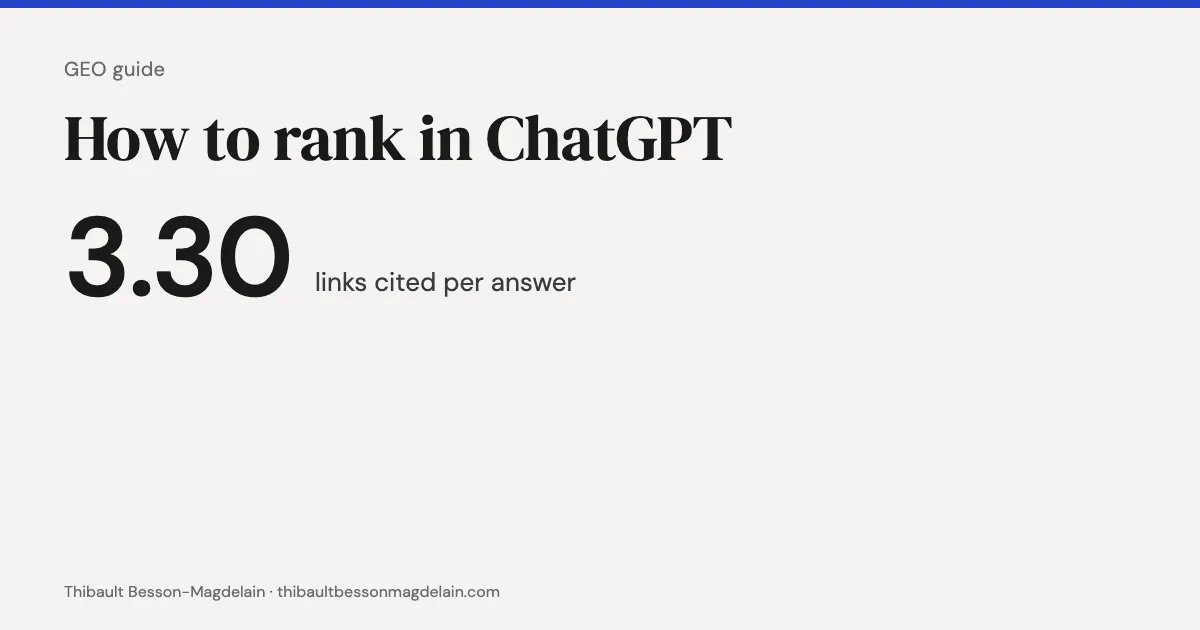
Sorank does not measure AI Overviews directly, but it does measure Gemini, the model family behind them, on 148,287 answers to business questions. Gemini cites far more links than other AIs (9.21 per answer, against 3.30 for ChatGPT), and its favorites are Trustpilot (4.31 citations per 100 answers), YouTube (4.02) and pagesjaunes.fr (3.45).
Treat this as an indication, not a map of AI Overviews: the Gemini app and the search features do not work identically, and the panel is mostly French (128,216 of the Gemini answers). Still, two patterns are hard to ignore. First, Google's AI loves Google's own platforms: Gemini cites YouTube 4.01 times per 100 answers, ChatGPT 0.06 times. Second, it leans on review platforms and directories, which hold the third-party proof about a business.
| Source | Gemini | ChatGPT | What it suggests for Google's AI |
|---|---|---|---|
| YouTube | 4.01 | 0.06 | Video pays off with Google, not with ChatGPT |
| Trustpilot | 3.93 | 1.83 | Reviews are a core proof |
| 1.47 | 0.14 | Forums count more with Google | |
| Wikipedia | 1.49 | 5.40 | Less central than for ChatGPT |
| 1.01 | 0.42 | Company and expert profiles help |
In English answers only (19,021 Gemini answers), the top sources are YouTube (2.22), Amazon (2.13), booking.com (2.09) and Reddit (1.94). For more on this model, see where Gemini gets its sources.
How do you optimize for AI Overviews?
You optimize for AI Overviews with solid SEO plus pages built to answer sub-questions in self-contained passages. There is no trick to add on top; the gains come from eligibility, clarity and reputation. Here is the order I would follow.
- Check eligibility. Make sure your key pages are indexed in Search Console, crawlable by Googlebot, and not blocked by nosnippet or max-snippet:0. A quick AI Overview check shows whether a query triggers one and who is cited.
- Map the sub-questions. For each target query, list the questions a careful reader would ask next: price, comparison, steps, risks, local options. Fan-out searches them; your page should answer them.
- Answer first, then detail. Put a two to four sentence answer under each question-shaped heading. Keep each section understandable on its own, with the subject named, not "it" or "this".
- Add the proof Google can verify. Numbers with their source, dates, author with real credentials, and structured data that matches the visible content. Schema is not required for AI Overviews, but it helps Google understand the entities on the page.
- Invest in Google's own surfaces. Given how much Gemini cites YouTube and review platforms, a short video answering your top question and an active review profile are worth more here than with ChatGPT.
- Earn links and mentions. Classic authority still decides which of two equally relevant pages wins.
Should you block AI Overviews from using your content?
Most businesses should not. Opting out removes you from the answers your buyers read, and Google says opted-out sites get no traffic or impressions from these features. It makes sense for publishers whose business is the content itself, and who would rather keep readers on their pages.
Google now gives four levers. Since 31 August 2026, a Search Console control available to all sites lets you decide "if they want their site to appear in and help ground responses in our generative AI Search features"; Google states it is not used as a ranking signal outside those features.
| Lever | Effect on AI Overviews | Effect on classic results |
|---|---|---|
| Search Console AI features control | Site no longer appears in or grounds AI Overviews and AI Mode | None, according to Google |
| nosnippet, data-nosnippet, max-snippet | Limits or removes text that can be shown | Shorter or no snippet |
| noindex | Page cannot be used | Page removed from results |
| Google-Extended in robots.txt | None: Google points to it for "Google's other systems", not Search | None |
The last line surprises many people: blocking Google-Extended does not take you out of AI Overviews. More on AI crawler rules in my guide to robots.txt for AI crawlers.
How do you measure your AI Overviews visibility?
Start in Search Console, then add a direct check. Clicks and impressions from AI features are included in the Web search type of the Performance report, without a separate filter. Since 2026, Google has added insights on which pages appear in AI responses and in which countries, with impression metrics.
- Search Console: watch pages whose impressions rise while clicks fall; that is often an AI Overview answering instead of you.
- Analytics: Google suggests tracking conversions and time on site, since it says AI Overview clicks are more engaged. My guide to AI traffic in Google Analytics shows how to separate it.
- Direct tracking: run your target queries every week and record whether you are cited. Tools like Sorank's AI visibility tracker do this across Google's AI and the other assistants.
So, how do you do SEO for Google AI Overviews?
You get cited in AI Overviews by being indexed and snippet-eligible, by answering each sub-question of a search in clear self-contained passages, and by having the reputation that classic SEO already rewards; there is no special file or markup to add. Expect fewer clicks on informational searches (8% against 15% in Pew's study) and aim for being the cited source, with extra effort on YouTube and reviews, which Google's AI cites far more than ChatGPT.
To see which of your pages Google's AI and the other assistants cite, and how that changes every week, track your Gemini and AI visibility with Sorank (plans on the pricing page).
Sources
- Google Search Central, "AI features and your website": eligibility, query fan-out, controls, reporting.
- Pew Research Center, 22 July 2025: clicks with and without an AI summary.
- Google, Sundar Pichai's I/O 2026 keynote, 19 May 2026: 2.5 billion monthly active users.
- Google, "New opportunities, control and insights for website owners", updated 31 August 2026: Search Console opt-out and AI insights.
- Google France, 22 July 2026: launch of AI Overviews and AI Mode in France.
- Sorank Data, snapshot of 2 November 2026: Gemini citation figures.
FAQ
Can I rank in AI Overviews without ranking in Google?
Not without being indexed and eligible for a snippet: that is Google's only requirement. But you do not need to rank first on the main query, because query fan-out also searches related sub-questions, and a page ranking for one of them can be cited.
Do I need schema markup to appear in AI Overviews?
No. Google states there is no special schema.org structured data needed for AI features. Structured data that matches the visible content still helps Google understand your page and is worth keeping for other search features.
How do I see AI Overviews traffic in Search Console?
Clicks and impressions from AI features are counted in the Web search type of the Performance report, without a separate filter. Since 2026, Search Console also shows insights on which pages appear in AI responses and in which countries.
Founder of Sorank, the SEO and GEO platform that tracks how ChatGPT, Gemini, Perplexity, Claude and Grok talk about brands. Before Sorank, I ran an SEO agency that served more than 100 clients. Based in Budapest.
Read next
-
llms.txt: What It Is, Who Reads It, and Is It Worth It?
What llms.txt is, who actually reads it according to the evidence, whether it is worth it, and an example file to copy.
-
Google AI Mode SEO: Query Fan-Out and How to Get Cited
How Google AI Mode works, what query fan-out changes for your pages, and how to get cited in its answers.
-
How to Rank in ChatGPT: 7 Steps Backed by Real Data
How ChatGPT picks the brands it recommends, what it cites, and the 7 steps to get into its answers.
Continue on AI visibility: all articles on the blog