Which Sources Does AI Cite? What 498,158 Answers Show
On business questions, AI leans on review platforms, official websites, Wikipedia and directories. Each model has its own favorites, and Reddit is far less important than you have been told.

Published · Updated · 12 min read
Contents
- Which websites does AI cite the most?
- Does each AI cite different sources?
- Does AI really cite Reddit that much?
- Do French and English answers cite the same sources?
- Which sources does AI cite in each industry?
- Are AI sources stable over time?
- How do you get your business cited by AI?
- How can you check which sources AI cites for your brand?
- What are the limits of this data?
- FAQ
Which sources does AI cite when someone asks it to recommend a business? I wanted numbers, not opinions, so I went through the 498,158 answers that Sorank collected from five AIs between August 2025 and October 2026. This matters because AI is now where people start: 34% of US adults had used ChatGPT by early 2025, according to Pew Research Center, and the French telecom regulator Arcep reports that 48% of people in France now use generative AI.
When those people ask for an accountant, a web agency or a project management tool, the AI does two things: it names a few companies, and it backs them with a few links. Those links are the sources. They decide who gets recommended and who does not exist. I build Sorank, a platform that tracks exactly this for its clients, so every week it asks the same buyer questions to ChatGPT, Gemini, Perplexity, Claude and Grok. The full dataset is public on sorank.com/data. Here is what it says.
Which websites does AI cite the most?
Across all five models, the most cited website is Trustpilot, with 2.56 citations per 100 answers, ahead of service-public.gouv.fr (2.36) and Wikipedia (2.08). The top 10 is made of review platforms, official government sites, an encyclopedia, directories and big platforms. Your own website is rarely what the AI quotes: it quotes what others say about you.
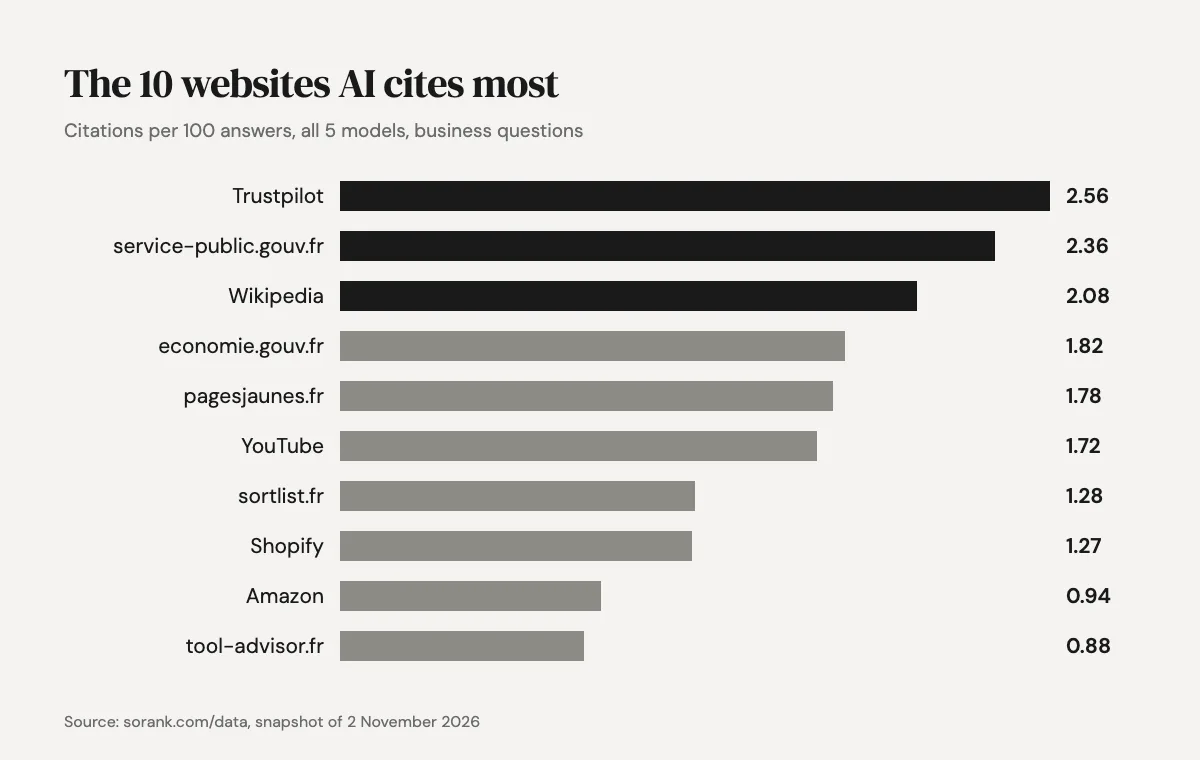
| Rank | Website | Type of source | Citations per 100 answers | Citations |
|---|---|---|---|---|
| 1 | Trustpilot | Review platform | 2.56 | 12,734 |
| 2 | service-public.gouv.fr | Official (French government) | 2.36 | 11,751 |
| 3 | Wikipedia | Encyclopedia | 2.08 | 10,381 |
| 4 | economie.gouv.fr | Official (French government) | 1.82 | 9,059 |
| 5 | pagesjaunes.fr | Business directory | 1.78 | 8,855 |
| 6 | YouTube | Video platform | 1.72 | 8,573 |
| 7 | sortlist.fr | Agency directory | 1.28 | 6,370 |
| 8 | Shopify | Software platform | 1.27 | 6,329 |
| 9 | Amazon | Marketplace | 0.94 | 4,668 |
| 10 | tool-advisor.fr | Software comparison site | 0.88 | 4,402 |
Read it as a map of trust. When an AI recommends a business, it looks for proof that other people vouch for it (reviews), official rules that frame the choice (government sites), neutral definitions (Wikipedia) and lists of providers (directories like PagesJaunes or Sortlist). In total, the dataset holds 2,527,026 citations spread over 184,406 different domains. The long tail is huge, but the top is concentrated.
My take after reading thousands of these replies: most businesses spend all their effort on their own website and none on the five or six third-party pages that actually feed the AI. That is backwards.
Does each AI cite different sources?
Yes, and the gap is large. ChatGPT cites official sites and Wikipedia, Gemini cites Trustpilot and YouTube, Perplexity cites YouTube and TripAdvisor, Claude cites directories like PagesJaunes, and Grok cites Sortlist and Trustpilot. Optimizing for "AI" in general does not mean much: you optimize for the sources of the models your buyers use.
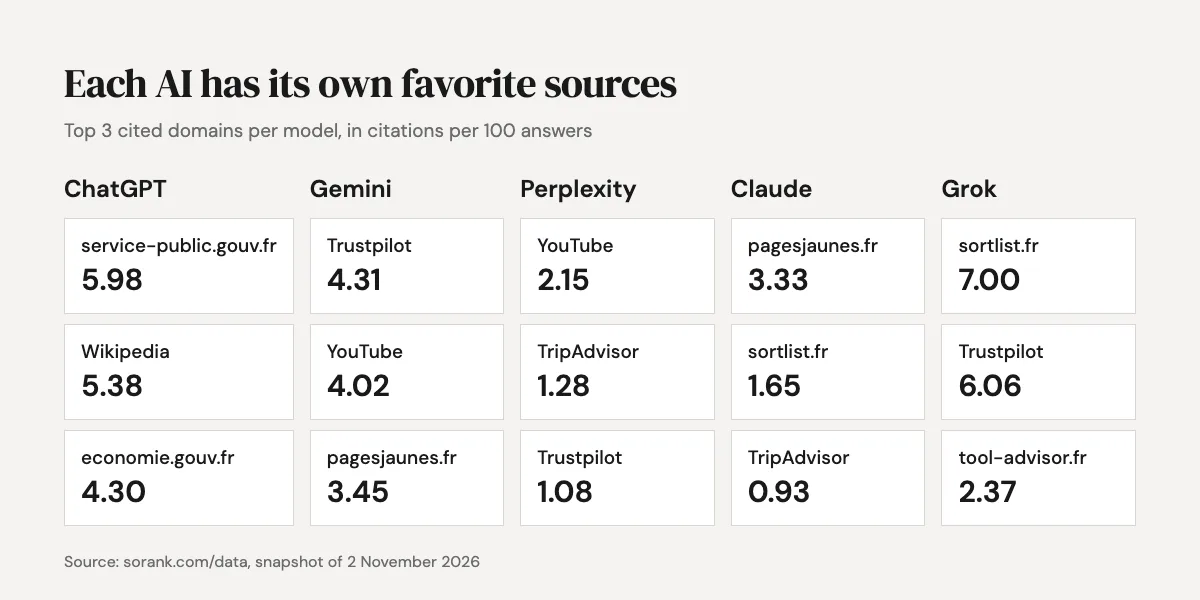
The table below compares the same platforms model by model. The contrasts are striking. ChatGPT cites Wikipedia 5.40 times per 100 answers, Claude only 0.13 times. Gemini cites YouTube 4.01 times per 100 answers, ChatGPT 0.06 times. Gemini and YouTube both belong to Google, which makes that one easy to understand.
| Platform | ChatGPT | Gemini | Perplexity | Claude | Grok |
|---|---|---|---|---|---|
| Trustpilot | 1.83 | 3.93 | 1.08 | 0.80 | 5.62 |
| Wikipedia | 5.40 | 1.49 | 0.12 | 0.13 | 0.46 |
| YouTube | 0.06 | 4.01 | 2.30 | 0.03 | 0.72 |
| Shopify | 1.04 | 1.92 | 0.63 | 0.42 | 0.83 |
| Amazon | 0.78 | 1.49 | 0.38 | 0.82 | 2.59 |
| TripAdvisor | 0.67 | 0.51 | 1.31 | 1.09 | 2.09 |
| 0.14 | 1.47 | 0.79 | 0.00 | 1.38 | |
| 0.42 | 1.01 | 0.73 | 0.16 | 1.05 |
Volume differs too. Across the 37 big platforms Sorank tracks (YouTube, Reddit, Wikipedia, Trustpilot and so on), Gemini cites them 4.5 times more than Claude: 25.37 citations per 100 answers against 5.59. Claude prefers smaller, specialized sources such as local directories. If your buyers live in Claude, a strong YouTube channel will not help you much there. If they live in Gemini, it will.
Does AI really cite Reddit that much?
Not on business questions. You have probably read that Reddit is the main source of AI answers. In this dataset, Reddit gets 0.47 citations per 100 answers and ranks 18th overall. Claude never cites it (0.00), and ChatGPT cites it 0.14 times per 100 answers.
Both things can be true. Studies that put Reddit first often mix every kind of question: product opinions, tech help, general knowledge, news. When the question is "which supplier should I pick", the AI wants verifiable signals, and a review platform or an official listing is easier to verify than a forum thread. Reddit matters more in English (see below) and with Gemini (1.47) and Grok (1.38).
My opinion: do not build a Reddit strategy because a viral post told you to. Check whether the AIs your buyers use actually cite Reddit for questions about your market. For most local services and B2B providers in Europe, the answer is no.
Do French and English answers cite the same sources?
No. The same kind of question returns different sources depending on the market's language. French replies lean on official and reference sites, while English ones lean on marketplaces, review platforms and communities.
| Source | French | English |
|---|---|---|
| Trustpilot | 2.69 | 1.70 |
| Wikipedia | 2.26 | 0.93 |
| YouTube | 1.66 | 1.06 |
| Amazon | 0.67 | 2.51 |
| 0.36 | 1.06 |
In French, the top 5 is service-public.gouv.fr and Trustpilot (2.69 each), Wikipedia (2.26), economie.gouv.fr (2.08) and pagesjaunes.fr (2.03). In English, it is Amazon (2.51), Trustpilot (1.70), ftc.gov (1.13), then YouTube and Reddit (1.06 each). Reddit is about three times more cited in English than in French. If you sell in several countries, you need one source plan per language, not one translated plan.
Which sources does AI cite in each industry?
The first source changes completely from one industry to the next. In beauty, planity.com gets 14.04 citations per 100 answers, more than five times Trustpilot's overall rate. In software it is Shopify (9.07), in marketing semrush.com (5.34), in IT services microsoft.com (6.00). The overall top 10 hides these local leaders, so always look at your own industry first.
| Industry | First source | Citations per 100 answers | Sample |
|---|---|---|---|
| Beauty | planity.com | 14.04 | 14,850 |
| Software | Shopify | 9.07 | 26,668 |
| Real estate | service-public.gouv.fr | 8.40 | 14,855 |
| Electronics | prusa3d.com | 7.66 | 16,825 |
| IT services | microsoft.com | 6.00 | 14,619 |
| Wellness | economie.gouv.fr | 5.98 | 21,518 |
| Construction | service-public.gouv.fr | 5.81 | 26,028 |
| Marketing | semrush.com | 5.34 | 27,360 |
Three patterns stand out. In regulated activities (real estate, construction, wellness), the AI first quotes the government page that sets the rules, then names providers. In booking-driven trades like beauty, the booking platform becomes the reference, because it holds the reviews, the prices and the availability. In tech, the platform's own documentation wins (Shopify, Microsoft, Prusa). If you sell in one of these markets, your profile on that one platform probably matters more than your next ten blog posts.
Are AI sources stable over time?
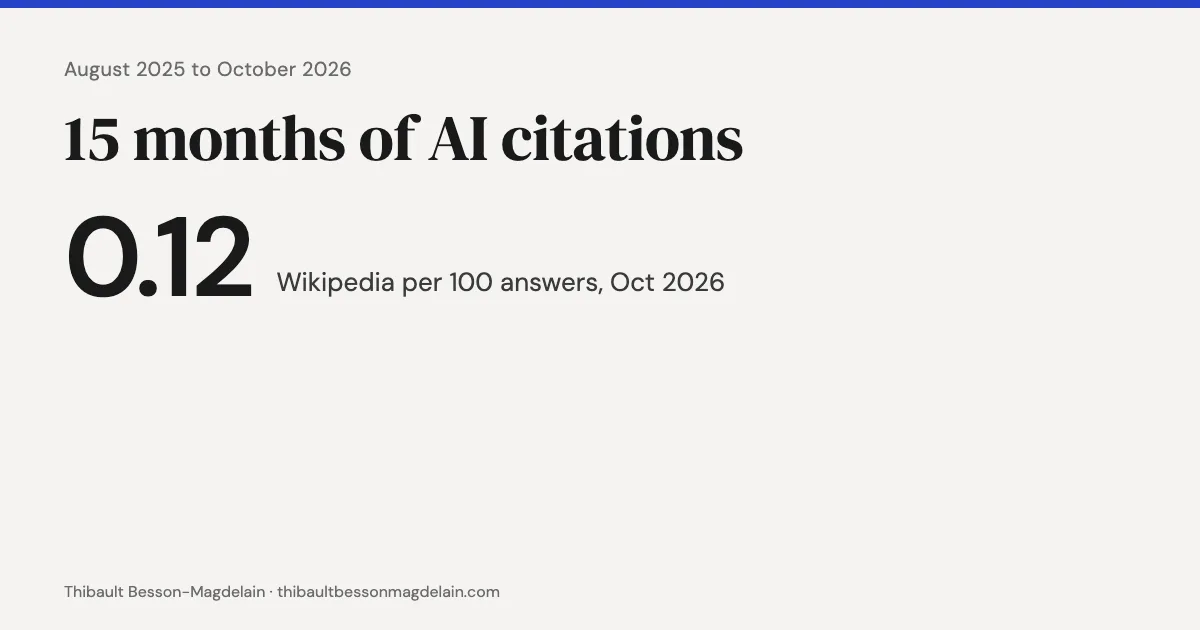
No, they move a lot from month to month. Wikipedia went from 11.31 citations per 100 answers in October 2025 to 0.12 in October 2026. YouTube went from 8.15 to 0.36 over the same period. Trustpilot rose from 0.29 to a peak of 4.44 in March 2026, then fell back to 1.27 in October 2026.
Part of this is the panel, not the models: Sorank analyzed 5,925 answers in October 2025 and 110,687 in October 2026, and the mix of industries changed as clients joined. Still, the lesson holds. A source that carries you this quarter can disappear next quarter. That is why I look at the trend over several months and never at a single value, and why tracking has to be monthly, model by model.
How do you get your business cited by AI?
You get cited by being present, accurate and well rated on the sources the AI already trusts in your market, and by making your own pages easy to quote. Here is the order I follow with Sorank clients.
- Find your market's sources. Start from the industry breakdowns on sorank.com/data: check the industry table above, then open your sector page.
- Fix your presence there. A complete, recent profile on the review platform and the directories that matter, with real reviews. An AI cannot cite a profile that does not exist.
- Make your own pages quotable. Clear answers at the top, numbers with their source, short self-contained sections. The researchers who coined the term put it plainly:
"GEO can boost visibility by up to 40% in generative engine responses."Aggarwal et al., GEO: Generative Engine Optimization, Princeton University and partners, KDD 2024
- Keep the SEO basics. Google is explicit about its own AI features: "There are no additional requirements to appear in AI Overviews or AI Mode, nor other special optimizations necessary" (Google Search Central). Indexable pages and clean technical SEO still come first.
- Measure every month, per model. Ask your buyers' real questions to each AI and record who is named and which links back them. You can do it by hand in a spreadsheet, or let Sorank's AI mention tracking run it every week (plans on the pricing page).
How can you check which sources AI cites for your brand?
Ask the AIs the questions your buyers ask, and write down the links. It takes about an hour the first time, and it is the most useful hour you will spend on AI visibility this month. This is the routine I used before automating it.
- Write 10 buyer questions. Not your brand name: real questions like "best accountant for freelancers in Lyon" or "which CRM for a 10 person sales team". Mix comparison, recommendation and trust questions ("is X reliable?").
- Ask them to each AI. ChatGPT, Gemini, Perplexity, Claude and Grok, with web search turned on when the option exists. Use a fresh session so your history does not bias the result.
- Record two columns per reply. The companies named, and the domains of the links given. After 50 replies (10 questions times 5 AIs), you will see the same five or six domains coming back.
- Compare with your presence. For each recurring domain: do you have a profile, is it complete, is it recent, are the reviews good? Every "no" is a task.
- Repeat next month. Same questions, same AIs. The change is the signal, as the Wikipedia and YouTube curves above show.
Doing this by hand works for a few questions. It breaks down when you need dozens of questions, five models and a weekly history, which is exactly why I built the AI mention tracking in Sorank.
What are the limits of this data?
This dataset shows which sources AI cites when asked about businesses, not what the public asks AI in general. The questions are the ones Sorank asks every week to track its clients' websites: finding a provider, comparing offers, checking if a company is reliable.
- French-heavy. 435,183 answers are for French-speaking markets and 59,825 for English-speaking ones, so the overall ranking leans toward French sources.
- Sector weight. Industries with more tracked websites weigh more in the totals.
- Unit. Figures are citations per 100 answers, not a percentage of answers: one reply can cite the same site for several recommended companies.
- No self-promotion. All replies about sorank.com itself are removed, so Sorank's own questions about SEO software do not distort the English figures.
- Lower ranks are minimums. Rankings are rebuilt from monthly top lists, so counts at the end of a list can be higher in reality. The full method is on the methodology page.
So, which sources does AI cite?
AI does not cite the web at random: on business questions it leans on review platforms, official websites, Wikipedia and directories, and each model has its own list. Trustpilot, service-public.gouv.fr and Wikipedia lead overall, ChatGPT and Gemini barely agree, and Reddit is a minor source for this kind of question. The businesses that get recommended are the ones that show up, accurately, where each AI already looks.
If you want to see where you stand, the fastest way is to check your brand in the five AIs this month. Start tracking your AI mentions with Sorank.
Sources
- Sorank Data, "The websites AI cites most", snapshot of 2 November 2026: every citation figure in this article.
- Sorank Data, methodology: sample, exclusions and limits.
- Aggarwal et al., "GEO: Generative Engine Optimization", KDD 2024: the up to 40% visibility gain.
- Pew Research Center, 25 June 2025: 34% of US adults have used ChatGPT.
- Arcep, digital barometer, February 2026: 48% of people in France use generative AI.
- Google Search Central, "AI features and your website": no special optimization required for AI Overviews and AI Mode.
FAQ
Where does ChatGPT get its sources from?
On business questions, ChatGPT relies most on official and reference websites: service-public.gouv.fr (5.98 citations per 100 answers), Wikipedia (5.38) and economie.gouv.fr (4.30) in this dataset. When it searches the web, it adds links to the pages it used to back the companies it recommends.
Which AI cites the most sources?
Gemini. Across the 37 big platforms tracked by Sorank, it cites them 4.5 times more than Claude: 25.37 citations per 100 answers against 5.59. Claude cites fewer big platforms and more specialized sources such as local directories.
How do I get my website cited by ChatGPT?
Be present and accurate on the sources ChatGPT already uses in your market, then make your own pages easy to quote with clear answers, sourced numbers and short self-contained sections. Measure the result every month by asking your buyers' real questions, because the sources change over time.
Founder of Sorank, the SEO and GEO platform that tracks how ChatGPT, Gemini, Perplexity, Claude and Grok talk about brands. Before Sorank, I ran an SEO agency that served more than 100 clients. Based in Budapest.
Read next
-
AI Answers in French vs English: Why the Sources Are Not the Same
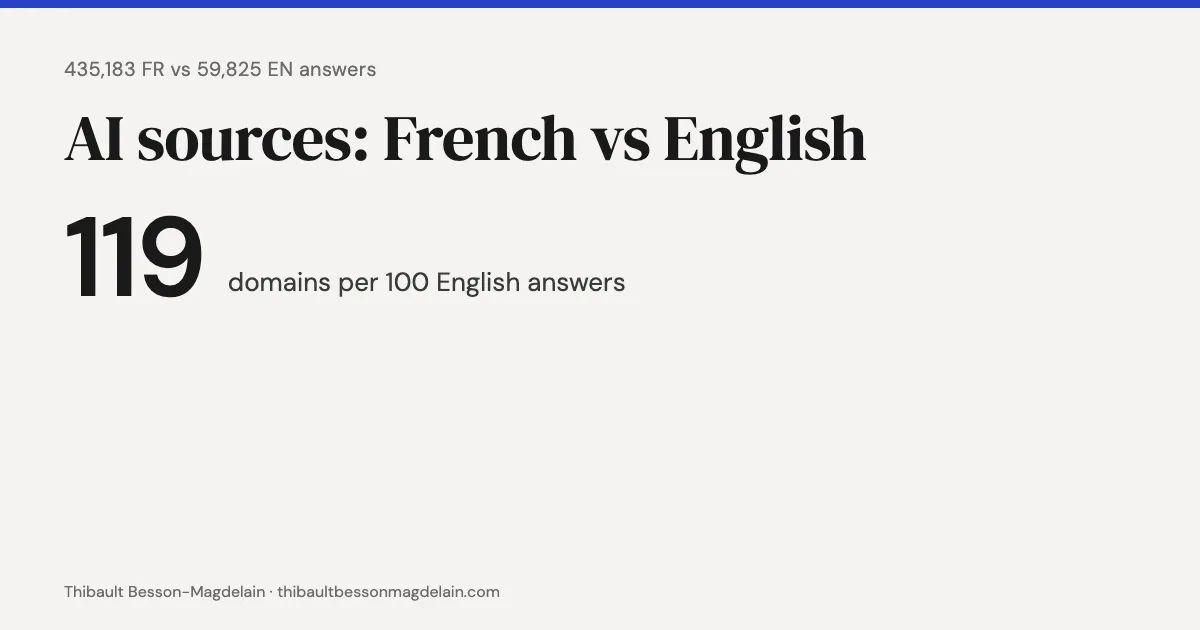
French AI answers cite government sites and directories; English ones cite Amazon, Reddit and brand websites.
-
AI Citation Trends: What 15 Months of AI Answers Show
Wikipedia fell from 11.31 to 0.12 citations per 100 AI answers in a year: 15 months of trends.
-
AI Search for Lawyers: What AIs Cite When People Ask Legal Questions
On 10,509 legal questions, AIs cite government sites first, then law firm websites and bar associations.
Continue on AI visibility: all articles on the blog