SaaS SEO: Build the Pages That Sell Before the Blog
Most software companies start SEO with a blog and wonder why traffic never turns into trials. The pages that sell software are features, use cases, integrations, comparisons and pricing. Here is how I would build SaaS SEO today, with data on what AI assistants cite when buyers ask about software.

Published · Updated · 10 min read
Contents
- What makes SEO for SaaS different?
- Which pages should a SaaS company build first?
- How do you write comparison and alternatives pages?
- Why do integration pages matter so much?
- What do AI assistants cite when buyers ask about software?
- What role should the blog play in SaaS SEO?
- How do SaaS companies earn links?
- How do you measure SaaS SEO?
- FAQ
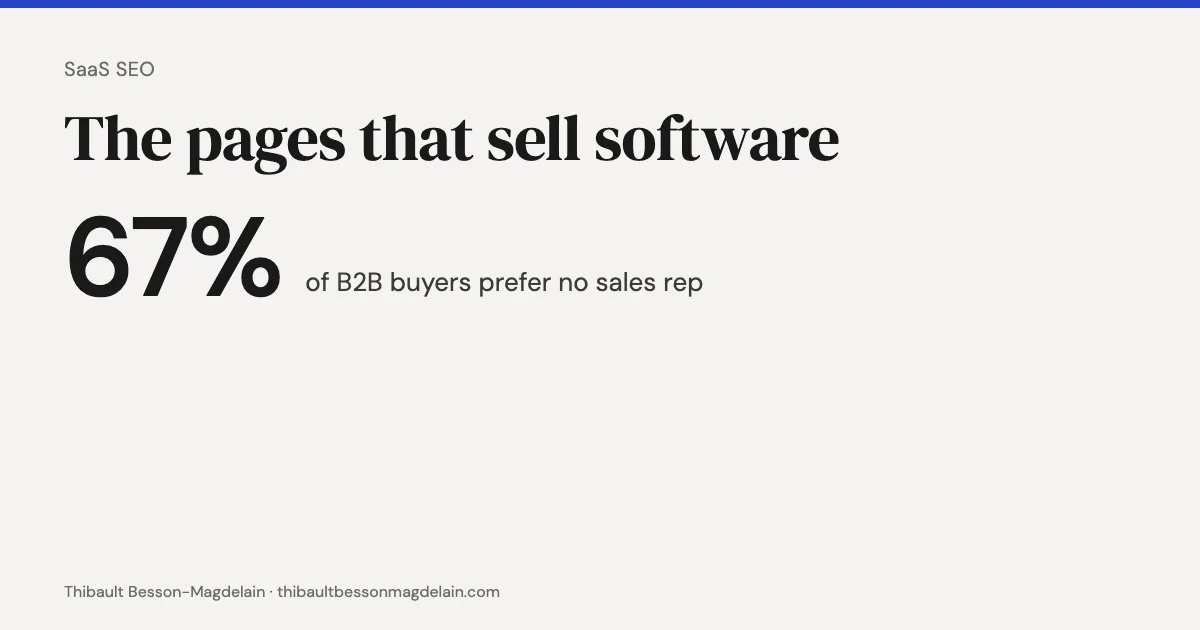
SaaS SEO is not about traffic. It is about being found at the moment a buyer compares tools, checks an integration or looks for an alternative to the software they already pay for. That moment increasingly happens without a salesperson: in a Gartner survey of 646 B2B buyers, 67% said they prefer a rep-free experience, and according to Digital Commerce 360's report on the same survey, 45% had used AI tools during a recent purchase.
I build Sorank, which is itself a software company, and before that I ran an SEO agency with more than 100 clients. The mistake I see most in software companies is the same: they start with a blog about their industry, get readers who will never buy, and leave the pages that sell to the product team. This guide is the order I would follow instead.
What makes SEO for SaaS different?
Three things. Buyers compare before they contact you, the product changes every month so pages go stale quickly, and the market is global, with competitors in every language. SaaS SEO is therefore less about volume and more about owning the comparison and evaluation queries of your category.
A software buyer's search journey usually looks like this: a problem ("how to track AI mentions of my brand"), a category ("AI visibility tool"), a shortlist ("best AI visibility tools"), a comparison ("tool A vs tool B"), a check ("tool A Shopify integration", "tool A pricing"), and finally a brand search. The first two steps bring volume. The last four bring customers. Most SaaS sites have content for step one and nothing for steps four and five.
The other difference is the free trial or demo. Your conversion is a signup, not a phone call, so every page that ranks should make the next step obvious, and you can measure precisely which pages produce trials.
Which pages should a SaaS company build first?
Build the pages closest to the purchase first: pricing, comparison and alternatives pages, integration pages, then use case and industry pages, and the main feature pages. They target fewer searches, but the people who search them are ready to choose.
| Page type | Example query | Search volume | Intent to buy | Priority |
|---|---|---|---|---|
| Alternatives | "[competitor] alternatives" | Low to medium | Very high | 1 |
| Comparison (X vs Y) | "[you] vs [competitor]" | Low | Very high | 1 |
| Pricing | "[you] pricing" | Low | Very high | 1 |
| Integration | "[category] for Shopify" | Low each, large in total | High | 2 |
| Use case, industry | "CRM for real estate agents" | Medium | High | 2 |
| Feature | "[category] with [feature]" | Low to medium | Medium to high | 2 |
| Free tool, template | "invoice template" | High | Low to medium | 3 |
| Blog guide | "how to [problem]" | High | Low | 3 |
Each of these pages should be written for a buyer, not a search engine: one problem, one answer, proof (screenshots, numbers, customer logos you are allowed to show), a clear price or a link to it, and one call to action.
How do you write comparison and alternatives pages?
Write them as honest buying guides, not as attack pages: a dated comparison table with facts the reader can check, the cases where the competitor is the better choice, and the cases where you are. Buyers read several of these pages, and AI assistants compare them too, so exaggeration gets caught.
Google's guidance on reviews is the best checklist I know for this kind of page, even though it was written for product reviews:
"Discuss the benefits and drawbacks of something, based on your own original research."Google Search Central, Write high quality reviews
The same page asks for quantitative measurements and evidence of first-hand use. Applied to software, that gives:
- A comparison table with dated facts. Price, key limits, integrations, support, data location. Write "checked on [date]" and update it.
- Screenshots of both products. Proof that you actually used the competitor.
- "Choose them if..." and "choose us if...". Saying where a competitor is better is what makes the rest credible.
- One page per real comparison. Only the competitors your buyers actually compare you with, not every name in the category.
- An alternatives hub. A page listing all your comparisons, linked from the footer and the pricing page.
Sorank does this with its own alternatives pages, if you want to see the format in practice.
Why do integration pages matter so much?
Because buyers search for software that works with what they already use, and because the ecosystems themselves are among the most cited sources. One page per integration ("[your category] for HubSpot", "[your tool] + Slack") catches specific, high intent searches that add up.
A good integration page explains what the integration does in the buyer's words, shows the setup in three steps, lists what data syncs, and links to the documentation. Then get listed in the partner's own marketplace or app directory: that listing is often the page Google and AI assistants find first, and it usually comes with a link.
The data supports this. In Sorank's software category, the most cited sources are the platforms and ecosystems themselves, as the next section shows.
What do AI assistants cite when buyers ask about software?
Platforms and documentation first. In the software questions of Sorank's dataset (26,668 answers, July to October 2026, snapshot of 2 November 2026), Shopify is cited 9.07 times per 100 answers, followed by woocommerce.com (2.39), GitHub (2.37) and cnil.fr (2.28), the French data protection authority. Software vendors' own sites also appear, which is rarer in other sectors.
Three lessons for a SaaS company:
- Ecosystems are sources. Shopify, WooCommerce, WordPress and GitHub pages get cited because they document the tools that work with them. Your integration listings and docs live there.
- Your own site can be cited. Salesforce, sage.com, antsroute.com and rentila.com appear in the top 10. Clear feature, use case and pricing pages are quotable.
- Review and comparison sites matter, but less than you think. g2.com gets 1.22 citations per 100 answers in this category, appvizer.fr 0.45 and tool-advisor.fr 0.37. Worth a complete profile, not your whole strategy.
Each model has its own habits. ChatGPT cites Shopify 10.99 times per 100 software answers and cnil.fr 5.43 times; Gemini cites Shopify 13.54 times; Claude cites apple.com first (5.71); Perplexity cites YouTube first (3.16). Grok has only 425 software answers in the sample, so its figures are indicative only. I go deeper into this in my article on AI search for SaaS. To check your own brand, Sorank's ChatGPT rank tracker shows where you appear on your buyers' prompts.
What role should the blog play in SaaS SEO?
The blog should support the pages that sell, not replace them. Write about the problems your product solves, link each article to the matching feature or use case page, and stop writing generic industry news that attracts readers who will never buy.
Good SaaS blog topics come from three places: the questions your sales and support teams answer every week, the queries in your Search Console (see my method for free keyword research), and original data from your product. The last one is the most powerful: it is the only content competitors cannot copy, and it earns links and AI citations on its own. Templates and free tools are also strong, because they solve a small problem right away and lead naturally to the product.
Then link it all together. Every article should point to at least one page that sells, and every page that sells should receive links from the related articles. My guide on internal linking covers the hub structure that works best for this.
How do SaaS companies earn links?
SaaS companies have link sources other businesses do not: integration partners, app marketplaces, review sites, customers' own sites and original product data. These are earned links, which means no policy risk.
- Partner directories. Every integration you build is a listing on the partner's marketplace, often with a link.
- Review and comparison sites. A complete, honest profile, with real reviews, on the sites your buyers use.
- Data studies. Aggregated, anonymized product data turned into a yearly or monthly report journalists can quote.
- Free tools. A calculator or checker that people link to because it is useful.
I detail what still works, and what Google considers link spam, in my guide on link building.
How do you measure SaaS SEO?
Measure trials and demos from organic search, by landing page, not just traffic. A comparison page with 200 visits and 15 signups is worth more than a guide with 20,000 visits and none. Then add the AI side: how often you are named when buyers ask assistants about your category.
- Signups by organic landing page. In your analytics, tie each trial to the first page of the session.
- Rankings on decision queries. "[competitor] alternatives", "[you] vs [competitor]", "[category] for [industry]".
- AI share of voice. On 20 to 50 buyer prompts, how often each model names you versus your competitors.
- Return on investment. Revenue from organic signups against the cost of content and tools. Sorank's SaaS SEO ROI calculator gives a quick estimate.
If you want rankings and AI mentions tracked in one place, the plans are on the Sorank pricing page.
So, what is the right SaaS SEO strategy?
The right SaaS SEO strategy builds the pages that sell first (pricing, honest comparison and alternatives pages, integration, use case and feature pages), then a blog that feeds them, earns links from partners and original data, and measures signups and AI mentions rather than traffic. Buyers now choose software mostly on their own, with search engines and AI assistants as their advisors. Your pages are the salespeople they talk to.
Start by checking whether AI assistants recommend you on your category's buyer questions. See how Sorank tracks it for software companies.
Sources
- Gartner, press release, 9 March 2026: 67% of B2B buyers prefer a rep-free experience (646 buyers).
- Digital Commerce 360, 17 March 2026: 45% of buyers used AI tools during a recent purchase.
- Google Search Central, "Write high quality reviews": benefits, drawbacks, original research.
- Sorank Data, snapshot of 2 November 2026: sources cited by AI in the software category.
FAQ
How long does SaaS SEO take to work?
Decision pages (comparisons, alternatives, integrations) can sometimes rank within weeks on low competition queries, because few competitors target them well. Category terms and broad guides take many months and need links. That is why it pays to start with the pages closest to the purchase.
Should SaaS companies create competitor comparison pages?
Yes, if they are honest. Buyers search for "[competitor] alternatives" and "X vs Y" when they are ready to choose. A fair page with a dated comparison table, screenshots and clear cases where each tool fits converts well and is more likely to be trusted by readers and AI assistants.
What is programmatic SEO for SaaS?
It means generating many pages from a template and a dataset, for example one page per integration or per industry. It works only when each page has unique, useful content (real setup steps, real data). Thin pages that only swap a name tend to go unindexed or drag the site down.
Founder of Sorank, the SEO and GEO platform that tracks how ChatGPT, Gemini, Perplexity, Claude and Grok talk about brands. Before Sorank, I ran an SEO agency that served more than 100 clients. Based in Budapest.
Read next
-
Free Keyword Research: How to Find the Right Keywords Without Paid Tools
Free keyword research with Search Console, autocomplete, Google Trends and AI prompts, turned into a keyword map.
-
Does Google Penalize AI Content? What It Really Punishes
Google does not penalize content for being AI-written. It punishes pages mass-produced to rank.
-
Internal Linking: A Simple Method to Push the Pages That Sell
My internal linking method: money pages, topic hubs, anchors, orphan pages and links AI crawlers can follow.
Continue on SEO: all articles on the blog