Link Building: What Still Works, and What Now Feeds AI Answers
Links still matter to Google, but the link that pays twice is the one on a site that AI assistants also cite. Here is how I rank link building tactics today, what Google calls spam, and what 2.5 million AI citations say about where to get mentioned.

Published · Updated · 10 min read
Contents
- Do backlinks still matter for SEO?
- Which link building tactics does Google treat as spam?
- How do links affect visibility in AI answers?
- Which link building tactics still work?
- How do you run digital PR on your own data?
- Should you chase links or brand mentions?
- How do you measure link building results?
- FAQ
Link building is not dead, but the version most people still sell is. Google's own documentation is clear that it uses links as a signal of relevance and to discover new pages, and just as clear that buying or exchanging links to manipulate rankings is spam. Meanwhile, a second audience has appeared: AI assistants like ChatGPT and Gemini, which recommend companies and back their answers with links to other websites. The question for link building today is no longer only "how many links", it is "on which sites".
Before building Sorank, I ran an SEO agency with more than 100 clients, so I have seen every flavor of link building, from honest outreach to private blog networks. Below is my current ranking of tactics, backed by Google's policies and by Sorank's public dataset of 498,158 AI answers.
Do backlinks still matter for SEO?
Yes. A backlink is a link from another site to yours, and Google states that it uses links as a signal when determining the relevancy of pages. What changed is the kind of link that counts: a few links from relevant, real sites that people read now outweigh hundreds of links from pages built only to host links.
Links do three jobs. They help Google find your pages. They pass authority, which helps competitive pages rank. And they send visitors, which is the part people forget. My rule of thumb: if a link would be worth having even if Google did not exist, because it brings readers or credibility, it is a good link. If its only value is "authority", be careful.
Links also matter less for some pages than others. A local plumber with ten good reviews and a complete business profile may rank without any link campaign. A software company competing on "best CRM" will not. Decide where links are the bottleneck before spending on them: if your pages are not indexed or do not match the search intent, links will not save them. That is why I always start with an SEO audit.
Which link building tactics does Google treat as spam?
Google defines link spam as creating links primarily to manipulate search rankings. Its spam policies name buying or selling links that pass ranking credit, excessive link exchanges, and links with optimized anchor text in articles, guest posts or press releases distributed on other sites.
"Link spam is the practice of creating links to or from a site primarily for the purpose of manipulating search rankings."Google Search Central, spam policies for Google web search
Paid placements are not forbidden in themselves. Google asks that they be labeled: its documentation says to mark advertisements or paid placements with the rel="sponsored" value. A sponsored article with a sponsored link is advertising. The same article with a followed, keyword-stuffed link is what the policy targets.
In practice, the market for paid articles is huge, especially in Europe, and plenty of sites buy links without labeling them. My honest view: it can work for a while, and it can also stop working overnight after an update, with no warning and no appeal. If you go that route, keep it a minority of your profile, pick sites with real traffic in your topic, vary anchors, and never on your only money page. Sorank keeps a non-sponsored comparison of link building platforms if you need to compare offers.
How do links affect visibility in AI answers?
AI assistants do not count your backlinks. They quote and link to the third-party pages that talk about you: review platforms, directories, comparison sites, official pages, encyclopedias. A mention on one of those sites is both a link for Google and a source for AI.
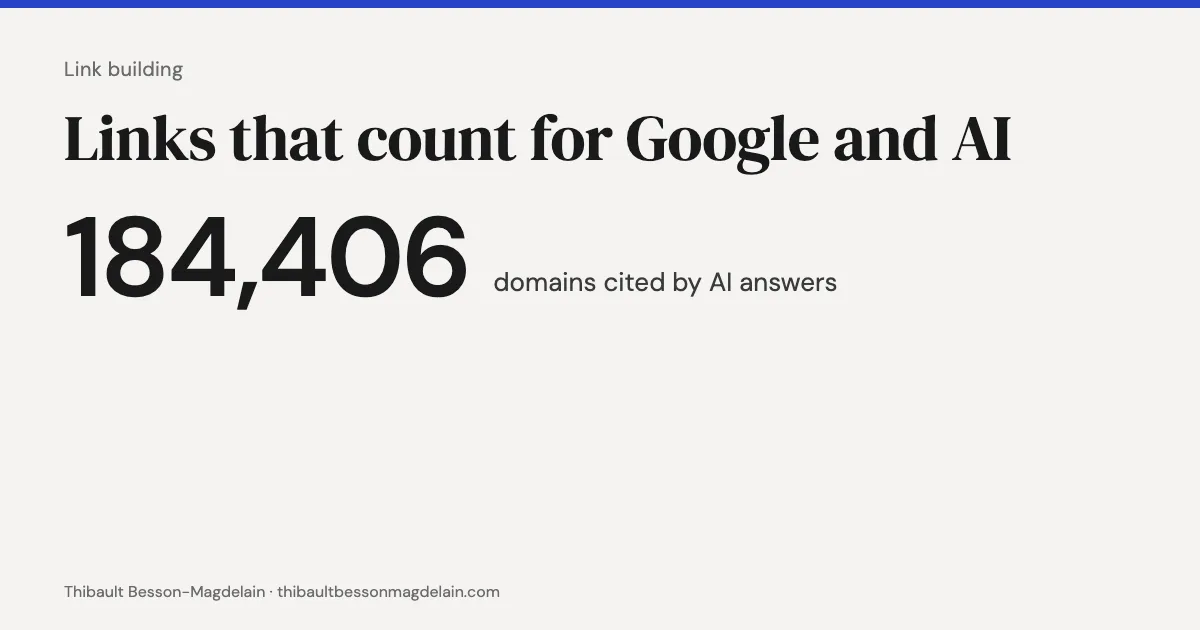
The spread is wide. In Sorank's dataset (snapshot of 2 November 2026), the 498,158 answers from ChatGPT, Gemini, Perplexity, Claude and Grok contain 2,527,026 citations spread over 184,406 different domains. The 10 most cited domains account for about 3.3% of citations, and the 50 most cited for about 5.6%. Everything else is a long tail of specialized sites.
Two lessons for link building. First, you do not need the giant sites: most citations go to niche sites, which is exactly where relevant links come from anyway. Second, some of the most cited domains are places where any business can earn a mention, and those are the links I would get first:
| Type of site | Example in the data | AI citations per 100 answers | Link value for Google | Effort |
|---|---|---|---|---|
| Review platform | Trustpilot | 2.56 | Low (often nofollow) | Ongoing |
| Encyclopedia | Wikipedia | 2.08 | Low (nofollow), strong trust | Hard, needs notability |
| Business directory | pagesjaunes.fr | 1.78 | Low to medium | Low |
| Video platform | YouTube | 1.72 | Low | High |
| Agency directory | sortlist.fr | 1.28 | Medium | Low |
| Software comparison site | tool-advisor.fr | 0.88 | Medium | Medium |
| Professional network | 0.51 | Low | Ongoing | |
| Forum | 0.47 | Low (ugc, nofollow) | High, must be genuine |
Notice the pattern: the sites with the highest AI value often give weak "SEO juice", and the reverse. That is why I now plan link building on two columns, one for Google authority and one for AI sources. More on this in which sources AI cites.
Which link building tactics still work?
The tactics that still work all have one thing in common: someone with editorial control chooses to link to you because it helps their readers. Here is how I rank them by value against effort.
- Profiles on directories and review platforms. Low effort, and these sites are among the most cited by AI. Complete every field, keep the description consistent with your site, collect real reviews.
- Reclaimed mentions. Search for your brand name in quotes and find pages that mention you without a link. A short, polite email asking the author to add one converts well, because the editorial decision is already made.
- Digital PR on your own data. The highest value and the highest effort. Detailed in the next section.
- Expert quotes for journalists. Answer journalist requests in your field with a specific, quotable answer. One good quote in a trade publication beats ten guest posts.
- Broken link building. Find dead pages in your niche that still receive links, create a better resource, and tell the linking sites. Still works, but it is slow.
- Selective guest posts. On sites your buyers actually read, with a natural link. Not as a volume play: Google's policy explicitly targets optimized anchors in guest posts distributed on other sites.
Then do not forget the links you control: internal linking decides where the authority from your backlinks flows once it arrives.
How do you run digital PR on your own data?
You publish a number nobody else has, from your own product, customers or research, and you pitch it to the journalists and newsletters who cover your field. Data gives them a story and a reason to cite you, and the citation usually comes with a link.
It also works for AI. The GEO study from Princeton and partners, which tested how to make content more visible in generative engine answers, found that its top-performing methods were citing sources, adding quotations and adding statistics:
"GEO can boost visibility by up to 40% in generative engine responses."Aggarwal et al., GEO: Generative Engine Optimization, KDD 2024
This is the approach I chose for Sorank: the AI citation dataset is public on sorank.com/data and anyone can quote it. My process:
- Find the data you already have. Usage data, anonymized customer trends, prices over time, survey answers. It must be real and reproducible.
- Extract one surprising finding. Not "we analyzed X", but "Reddit is cited 0.47 times per 100 business answers, far less than people think". A headline a journalist can use as is.
- Publish a citable page. The finding at the top, a chart, the method and its limits, a date. Make it easy to quote and easy to link.
- Pitch narrowly. Ten journalists who cover exactly that topic, with a personal note and the one number that matters to their readers.
- Update it. A dataset refreshed every month gets cited again every month. A one-off study is forgotten in a quarter.
Should you chase links or brand mentions?
Chase both, but count mentions as a result in themselves. A brand named on a trusted site without a link still helps AI assistants associate your name with a topic, and a mention is often the first step toward a link.
For Google, the link remains the unit of value. For AI answers, what matters is whether your brand appears, accurately described, on the pages the models read and cite. In practice, I track three things side by side: new referring domains, new mentions on sites that AI cites in my market, and how often the AIs name the brand when buyers ask. The third one is the real output; the first two are inputs.
How do you measure link building results?
Measure outcomes on the pages you built links to, not the link count. Did the target page gain positions and clicks in Search Console? Did AI assistants start naming you on buyer questions? Links are a cost; rankings, mentions and leads are the result.
- Referring domains to key pages: the Links report in Search Console is free and sufficient. You can also run a quick backlink analysis.
- Rankings and clicks of the target pages: compare 8 to 12 weeks before and after.
- AI mentions: ask the same buyer questions every month to each AI and note whether you are named and which sources are cited.
If you want the AI side tracked weekly across five models alongside your Google rankings, see the plans on the Sorank pricing page.
So, what link building still works?
The link building that still works earns editorial links and mentions on relevant sites, starting with the directories, review platforms and comparison sites that AI assistants already cite, and grows through digital PR built on your own data. Bought or exchanged links made to manipulate rankings remain spam under Google's policies, and they do nothing for your AI visibility. Plan on two columns, Google authority and AI sources, and measure results on the pages and prompts that matter.
Start by finding out which sites the AIs cite in your market. Track your AI mentions with Sorank.
Sources
- Google Search Central, "Spam policies for Google web search": definition of link spam.
- Google Search Central, "Link best practices for Google": links as a relevance signal.
- Google Search Central, "Qualify your outbound links to Google": rel="sponsored" for paid placements.
- Aggarwal et al., "GEO: Generative Engine Optimization", KDD 2024: up to 40% visibility gain.
- Sorank Data, snapshot of 2 November 2026: citations, domains and rates per source.
FAQ
Is link building still worth it?
Yes, for competitive queries. Google still uses links as a relevance signal. What is no longer worth it is volume: dozens of low quality or paid links can be ignored or penalized, while a few links from relevant sites, ideally sites that AI assistants also cite, keep paying off.
Is buying backlinks against Google's rules?
Buying links that pass ranking credit is listed as link spam in Google's policies. Paid placements are allowed if the link is labeled with rel="sponsored" (or nofollow), which means it is treated as advertising and does not pass ranking credit.
What is the safest way to get backlinks?
Earn them: complete profiles on the directories and review platforms of your market, reclaim unlinked mentions of your brand, answer journalists with expert quotes, and publish original data others want to cite. These links are editorial, so they carry no policy risk.
Founder of Sorank, the SEO and GEO platform that tracks how ChatGPT, Gemini, Perplexity, Claude and Grok talk about brands. Before Sorank, I ran an SEO agency that served more than 100 clients. Based in Budapest.
Read next
-
SEO Audit Checklist: What to Check First, and What to Skip
The SEO audit checklist in the order that matters: crawl, indexing, pages, links, then AI visibility, with free tools.
-
Internal Linking: A Simple Method to Push the Pages That Sell
My internal linking method: money pages, topic hubs, anchors, orphan pages and links AI crawlers can follow.
-
Free Keyword Research: How to Find the Right Keywords Without Paid Tools
Free keyword research with Search Console, autocomplete, Google Trends and AI prompts, turned into a keyword map.
Continue on SEO: all articles on the blog