How to Respond to Negative Reviews (With Templates)
A reply to a bad review is read by every future customer, and the review pages that hold it are among the sources AI cites most. Here is the structure I recommend, with templates for six common cases.

Published · Updated · 10 min read
Contents
- Should you respond to every negative review?
- Why do your replies matter for AI search?
- What should a reply to a negative review include?
- Which templates can you use for common situations?
- Which mistakes make a negative review worse?
- How fast should you respond?
- When should you report a review instead of replying?
- How do you turn negative reviews into an asset?
- FAQ
How to respond to negative reviews is not a customer service detail anymore: your reply is public, it stays next to the complaint for years, and it is read by future buyers and by the AI tools that recommend businesses. Google's own guidance for business owners is short and blunt: "Keep it short and simple: Customers value direct and honest responses". Research backs the habit of replying: in a study of hotel reviews published in Marketing Science, hotels that started responding saw a 0.12 star increase in ratings and a 12% increase in review volume.
I ran an SEO agency with more than 100 clients before building Sorank. Today, Sorank tracks which websites ChatGPT, Gemini, Perplexity, Claude and Grok cite when they recommend a company, and review platforms sit at the top of that list. So this guide covers both sides: the rules and templates for a good reply, and why that reply now matters for AI visibility too.
Should you respond to every negative review?
Yes, answer every negative review that a real customer could have written, and do it within a few days. Silence reads as indifference to the next buyer, and a calm reply is the only part of the page you control. The exception is a review that breaks the platform's rules (spam, hate, a competitor, someone who was never a customer): report it first, and reply only with a short factual note.
The Marketing Science study by Davide Proserpio and Georgios Zervas is the most solid evidence I know on the effect of replies. They compared the same hotels on TripAdvisor, where managers reply, and on Expedia, where they almost never do. Beyond the rating gain, they found a subtle effect that every business owner should know:
"Unsatisfied consumers become less likely to leave short indefensible reviews when hotels are likely to scrutinize them."Davide Proserpio and Georgios Zervas, "Online Reputation Management: Estimating the Impact of Management Responses on Consumer Reviews", Marketing Science, 2017
In plain words: when people see that the owner reads and answers, they stop posting lazy one-liners. You get fewer negative reviews, but the ones you get are longer and more detailed. That is a good trade, because a detailed complaint tells you what to fix.
Why do your replies matter for AI search?
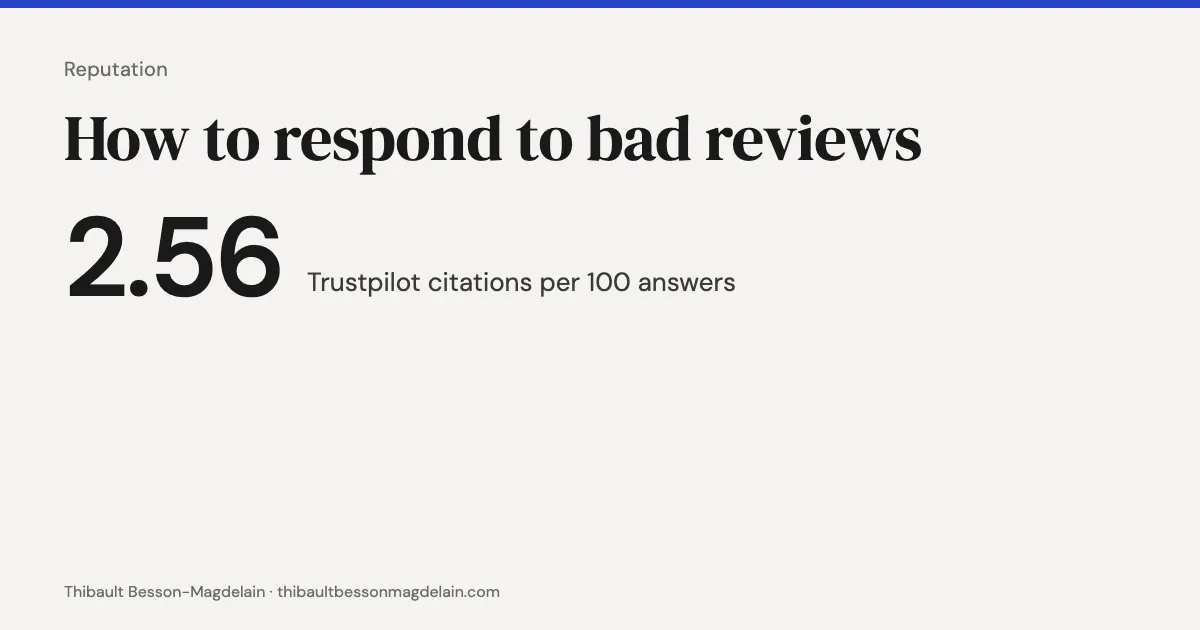
Because AI assistants cite review pages when they recommend a business, and those pages show your replies next to the complaints. In Sorank's data, Trustpilot is the most cited website of all, with 2.56 citations per 100 AI answers (snapshot of 2 November 2026, 498,158 answers). A review page with ten unanswered one-star reviews is one of the things an AI can link to when someone asks about you.
The weight differs by model. Grok cites Trustpilot 6.06 times per 100 answers and Gemini 4.31 times, while Claude cites it only 0.66 times and relies more on directories like PagesJaunes (3.33). In other words, if your buyers use Gemini or Grok, your Trustpilot page is part of your sales pitch whether you like it or not.
The industry view is even clearer. When the question is about a restaurant, the first source quoted is TripAdvisor (17.26 citations per 100 answers). For hotels it is booking.com (15.05), for beauty salons planity.com (14.04), for home services PagesJaunes (7.72). These are review and booking platforms, and every one of them displays owner replies.
My view: I do not think an AI "scores" the tone of your replies, and I have no data showing that. What I know is that the page it links to is the page a buyer will open. That page should show a business that listens. Before you rewrite your reply process, it is worth checking which review sites the AIs actually cite in your market; the Sorank data page breaks it down by industry and by model.
What should a reply to a negative review include?
A good reply has five parts: thanks with the person's name, the exact problem restated, a short acknowledgement, a concrete fix, and a way to continue privately, signed by a real person. It should fit in four to six sentences. Anything longer starts to look like a defense, and readers side with the customer when a business argues.
Google lists the same principles in its help center for business profiles: be professional and polite, keep it short, be conversational rather than promotional, personalize the reply, respond in a timely manner, and never share a reviewer's private information. Trustpilot's guidelines for businesses go further: replies must stay "polite and professional", and Trustpilot removes replies that include personal information, threats or aggressive language.
Which templates can you use for common situations?
Use the templates below as a skeleton, never as copy-paste. Change the first and last sentence every time, and quote one detail from the review. A reply that could be pasted under any review convinces nobody, and a page full of identical replies looks automated.
| Situation | What to say | What to avoid |
|---|---|---|
| Real service failure | "Thank you, Sarah. You waited 40 minutes for a table you had booked, and that is on us. We have changed how we confirm bookings. I would like to make it right: write to me at manager@..." | Explaining the staffing problem in detail |
| Late delivery or product defect | "Thanks, Tom. Your order arrived nine days late and the box was damaged. We have sent a replacement today and refunded the shipping." | Blaming the carrier |
| Rude staff member | "Thank you for telling us, Anna. Nobody should be spoken to like that. I have discussed it with the team and would like to hear the details from you directly." | Naming or defending the employee |
| Star rating with no text | "Thanks for your rating. We would like to understand what went wrong; could you tell us at hello@...?" | Asking them to remove it |
| Factually wrong review | "Thank you for your feedback. We could not find a booking under this name; if we missed something, please contact me at..." | Calling the person a liar |
| Fake or competitor review | Report it to the platform first. If it stays online: "We have no record of this visit and have reported the review. If you were a customer, please contact us." | Accusations you cannot prove |
Two details make a big difference. First, sign with a first name and a role ("Julie, manager"). It turns a brand into a person. Second, if you promise a follow-up, do it, and when the customer is satisfied, you can politely ask whether they would like to update their review. Never make that request a condition of the refund.
Which mistakes make a negative review worse?
The worst mistakes are arguing in public, revealing private details about the customer, threatening legal action, and answering with a generic sentence pasted under every review. Each of these turns one unhappy customer into a public story that the next hundred visitors will read.
- Replying in anger. Write the draft, wait a few hours, then cut half of it.
- Sharing personal data. Order numbers, health details, addresses: never in a public reply. It breaks Google's and Trustpilot's rules and, in Europe, data protection law.
- Threatening the reviewer. In the United States, the Federal Trade Commission's rule on fake reviews, announced on 14 August 2024, prohibits businesses from using unfounded legal threats, physical threats or intimidation to remove negative reviews.
- Copy-paste replies. "We are sorry for your experience, please contact us" under 50 reviews tells readers nobody reads them.
- Offering compensation for a deletion. Buying a review change is a form of review manipulation, and the platforms treat it that way.
- Selling in the reply. A promo code under a complaint looks cynical. Google explicitly advises against promotional replies.
How fast should you respond?
Within 48 hours is a good standard, and within a week at the latest. Speed matters less than quality, but a reply posted three months later looks like a clean-up operation rather than care. Set one person in charge, check the platforms twice a week, and use the platform notifications so nothing slips.
In practice, the problem is rarely writing the reply. It is knowing that a review exists. A typical business can have a Google profile, a Trustpilot page, two or three directory listings and a sector platform, and it is easy to watch only one of them. Make the list of every place where people can review you, then decide who watches each one. For local businesses, Google remains the first place to check; our guide on local SEO covers the profile side.
When should you report a review instead of replying?
Report a review when it breaks the platform's rules: spam, hate speech, conflicts of interest, personal information, or content about a different business. Disagreeing with a review is not a reason. Trustpilot says it in plain words: "Not liking a star rating or disagreeing with a negative review is not a valid reason for flagging it."
Reporting and replying are not exclusive. A fake review can stay online for days while the platform investigates (on Trustpilot, flagged reviews remain visible during the investigation), so a short, factual reply protects you in the meantime. I explain the removal process, with the legal route in Europe, in a separate guide on how to remove a Google review.
How do you turn negative reviews into an asset?
Treat each negative review as free consulting: tag it by cause, count the causes every month, and fix the one that comes back most. Then make sure the volume of recent positive reviews outweighs the old negative ones, because buyers and AI tools both look at recent reviews first.
- Tag the cause. Price, delay, quality, staff, communication. A simple spreadsheet is enough.
- Fix the top cause. Then say so in later replies: "We have changed X since then."
- Ask happy customers. A steady flow of genuine reviews is the best answer to an old bad one. I cover the legitimate methods in how to get Trustpilot reviews.
- Check what AI says. Ask ChatGPT, Gemini and Perplexity "is [your company] reliable?" and look at which pages they cite. If a review page shows up, it deserves your attention first. You can run this by hand, or follow it every week with Sorank's AI visibility tracker.
Reviews are one piece of a wider picture. If you want the full method, from Google results to AI answers, read my guide to online reputation management, and for the data on which sources AI quotes, which sources AI cites.
So, how should you respond to negative reviews?
Respond to every genuine negative review within a few days, in four to six sentences: thank the person, restate the problem, own your part, give a concrete fix, and offer a direct contact, signed by a real person. Report only the reviews that break the rules, never threaten, never copy-paste. Your replies are read by buyers today and by the AI tools that cite review pages tomorrow: in Sorank's data, Trustpilot alone is cited 2.56 times per 100 AI answers.
If you want to see which review pages the AIs show when people ask about your business, start there. Track your AI mentions with Sorank (plans on the pricing page).
Sources
- Sorank Data, AI citation study, snapshot of 2 November 2026: Trustpilot and industry citation rates.
- Proserpio and Zervas, "Online Reputation Management", Marketing Science, 2017: 0.12 star and 12% review volume increase.
- Google Business Profile Help, "Tips to get more reviews": Google's rules for replying to reviews.
- Trustpilot, Guidelines for Businesses: reply and flagging rules.
- Federal Trade Commission, 14 August 2024: final rule banning fake reviews and review suppression.
FAQ
What is the best response to a bad review?
A short, personal reply that thanks the customer by name, restates the exact problem, acknowledges your part, explains what you changed or offer, and gives a direct contact to continue privately. Four to six sentences, signed by a real person.
Should I respond to a 1-star review with no comment?
Yes, briefly. Thank the person for the rating and invite them to explain what went wrong through a direct email or phone line. Do not ask them to remove it, and do not guess what the problem was.
Can responding to negative reviews improve my rating?
It can. In the Marketing Science study by Proserpio and Zervas, hotels that started responding on TripAdvisor saw a 0.12 star increase in ratings and 12% more reviews, partly because unhappy customers posted fewer short, unfounded complaints.
Founder of Sorank, the SEO and GEO platform that tracks how ChatGPT, Gemini, Perplexity, Claude and Grok talk about brands. Before Sorank, I ran an SEO agency that served more than 100 clients. Based in Budapest.
Read next
-
How to Get Trustpilot Reviews, the Legit Way, and Why AI Cares
Invite every customer, offer no incentive, reply, and why AI cites Trustpilot more than any site.
-
How to Remove a Google Review: What Google Deletes and What Stays
What Google deletes, how to report and appeal, the legal route in the EU and US, and what to do with a review that stays.
-
Online Reputation Management: Your Brand in Google and in AI
What Google and AI say about your brand, which sources they quote, and how to improve it.
Continue on reputation and AI visibility: all articles on the blog