Local SEO: How to Rank on Google Maps and in AI Answers
Local SEO used to mean one thing: the map pack. Now the same customer may ask ChatGPT or Gemini instead. Here is how Google ranks local businesses, what to fix first, and which directories AI assistants actually cite for local questions.

Published · Updated · 10 min read
Contents
Local SEO is the work that makes a business show up when someone nearby searches for what it sells: "plumber near me", "Italian restaurant Lyon", "accountant for freelancers in Brussels". On Google it decides who appears in the map pack, the block of three businesses with a map above the regular results. And Google is clear about one thing in its official help page on local ranking: "There's no way to request or pay for a better local ranking on Google."
What changed is where the search starts. 34% of US adults had used ChatGPT by early 2025, according to Pew Research Center, and more of them now ask it for a provider. AI assistants do not read your Business Profile the way Google Maps does: they lean on directories, booking platforms and review sites. I built Sorank to track exactly that, and its public dataset of 498158 AI answers shows which sites they cite for local businesses. This guide covers both sides: Google first, then AI.
What is local SEO?
Local SEO is optimizing a business to appear in searches with a local intent, on Google Maps, in the map pack, in regular results and now in AI answers. It applies to any business that serves customers in a given area: shops, restaurants, trades, clinics, law firms, agencies.
It rests on four assets: your Google Business Profile (the listing shown on Maps), your reviews, your website (with pages that match each service and area), and your presence on third-party sites: directories, booking platforms, local press. Google uses all four. AI assistants use mostly the last two.
How does Google rank local businesses?
Google combines relevance, distance and prominence. Relevance is how well your profile matches the search, distance is how far you are from the searcher, and prominence is how well-known your business is, online and offline. You control relevance and prominence; distance is a fact.
"Relevance is how well a Business Profile matches what someone is searching for. Distance refers to how far each business is from the customer who's searching. Prominence means how well-known a business is."Google Business Profile Help, Tips to improve your local ranking on Google
Prominence is the one people underestimate. Google says it is based on information such as how many websites link to your business and how many reviews you have. That is close to what AI assistants look for too. A business that is well documented across the web wins in both places.
How do you optimize your Google Business Profile?
Make it complete, accurate and alive: the right primary category, real hours, real photos, a description that says what you do and where, and regular activity. In my view, the basics matter far more than advanced tactics.
- Claim and verify the profile. Without verification, you control nothing.
- Use your real business name. Google's guidelines for representing your business say the name "should reflect your business's real-world name" and that adding unnecessary information is not permitted. Stuffing "best plumber Paris" into the name risks suspension.
- Pick the most precise primary category. "Family law attorney" beats "Lawyer" when that is what you do. Add secondary categories only for services you actually offer.
- Hours, phone, website, address. Identical everywhere they appear. If you serve customers at their place and do not receive them, Google asks service-area businesses to hide their address.
- Photos and services. Real photos of the place, the team, the work. List each service with a short description.
- Keep it active. Answer reviews, publish updates, keep holiday hours current. An abandoned profile sends the wrong signal to customers first.
Do reviews matter for local SEO?
Yes. Google states it directly: "More reviews and positive ratings can help your business's local ranking." Reviews are also the raw material AI assistants quote when they recommend a business, so they now count twice.
In the Sorank dataset, Trustpilot is the most cited site across all AI answers, with 2.56 citations per 100 answers (snapshot of 2 November 2026). For local trades, the review platform that matters is often the one specific to your sector: TripAdvisor for restaurants, Planity for hair and beauty salons in France, Doctolib for health practitioners. Ask every satisfied customer, make it easy with a direct link, and answer every review, the negative ones first. I go deeper in how to respond to negative reviews.
Do you need local pages on your website?
Yes, one page per real location, and one page per real service. No, if it means hundreds of "service + city" pages with swapped words. Google's spam policies treat many near-identical pages made to rank as scaled content abuse, and those pages rarely convert anyway.
A good local page has an address, a map, opening hours, the team on site, photos of the place, the services offered there, local reviews and practical details (parking, access). If you serve an area from one base, one strong service page that lists the towns you cover beats twenty thin city pages. Add LocalBusiness structured data, which Google documents as a way to tell it about "business hours, different departments within a business" and more. If you use AI to write these pages, read what Google punishes in AI content first.
How do AI assistants answer local queries?
They name a few businesses and back them with links to directories, booking platforms and review sites, rarely to the businesses' own websites. Which platform depends on the trade, and on the AI.
By industry, the first source is almost always the dominant platform of the trade. Industry classification in the Sorank dataset starts in July 2026; the figures below cover July to October 2026.
By AI, the gap is just as large. In French-language answers, Gemini cites pagesjaunes.fr 3.99 times per 100 answers and Claude 3.78 times, while ChatGPT cites it only 0.34 times and prefers official sites. A listing on the main national directory is worth a lot in Gemini and Claude, much less in ChatGPT.
A caveat on the data: the panel is mostly French-speaking markets (435183 French answers against 59825 English ones). In English answers, the directory that appears is bbb.org (Better Business Bureau), with 0.54 citations per 100 answers, and Yelp does not make the top 50. My reading is that the logic transfers, not the names: each AI leans on the dominant directory of the market, so find yours by asking the AIs directly. The analysis of business directories in AI search goes further.
Which directories matter for local SEO?
The ones that rank on Google for your trade and city, and the ones AIs cite in your industry. Not hundreds of low-quality directories: a handful of accurate, complete listings is enough.
| Industry | First source cited by AI | Citations per 100 answers | Answers | What to do |
|---|---|---|---|---|
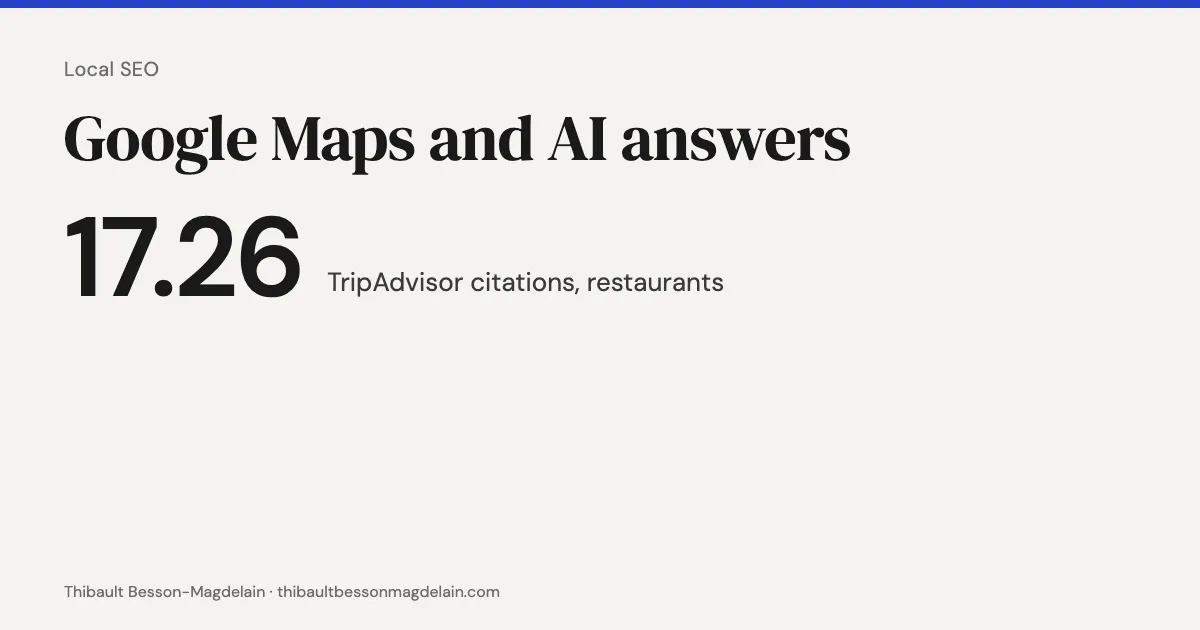
| Restaurants | TripAdvisor | 17.26 | 7,675 | Complete listing, photos, recent reviews |
| Hotels and rentals | booking.com | 15.05 | 7,680 | Be listed, keep ratings and answers current |
| Beauty | planity.com | 14.04 | 14,850 | Online booking profile with reviews |
| Healthcare | ameli.fr | 11.58 | 7,125 | Check your official listing, then booking platforms |
| Home services | pagesjaunes.fr | 7.72 | 13,510 | Claim and complete the directory listing |
| Construction | service-public.gouv.fr | 5.81 | 26,028 | pagesjaunes.fr is second (5.50): claim it |
Consistency matters more than volume. Your name, address and phone (often called NAP) should be identical on your profile, your site and every listing. When AIs find conflicting hours or two phone numbers, they either skip you or repeat the wrong one. Sorank's directories study lists the directories cited by industry if you want to go further.
How do you measure local SEO?
Track three things: your Business Profile performance, your local rankings, and your mentions in AI answers. The first two tell you how Google sees you, the third how AI assistants do.
- Business Profile performance. Calls, direction requests, website clicks and searches that found you, in the profile's own statistics.
- Local rankings. Your position for "service + city" queries, measured from the area you serve, since distance changes results. Search Console shows the queries that bring clicks to your site.
- AI mentions. Ask the questions your customers ask ("best electrician in Nantes", "emergency dentist open Sunday in Lille") to ChatGPT, Gemini, Perplexity, Claude and Grok, and note who is named and which sources back them. Repeat monthly.
The third one is the newest and the one most businesses skip. You can do it by hand in a spreadsheet, or let Sorank's AI mention tracking run it every week. To estimate what better local visibility is worth, the free local SEO ROI calculator gives an order of magnitude. Contractors will find sector-specific data in AI search for contractors.
So, how do you do local SEO today?
Local SEO means a complete Google Business Profile, a steady flow of real reviews, one useful page per location and service, and accurate listings on the platforms each AI already cites for your trade. Google ranks on relevance, distance and prominence; AI assistants rank on what the web says about you. Work on both, and measure both.
To see whether AI assistants recommend you in your city, compare Sorank's plans.
Sources
- Google Business Profile Help, "Tips to improve your local ranking on Google": relevance, distance, prominence; reviews; no paid ranking.
- Google Business Profile Help, "Guidelines for representing your business on Google": real-world name, service-area businesses.
- Google Search Central, "Local business structured data": hours, departments and more.
- Pew Research Center, 25 June 2025: 34% of US adults have used ChatGPT.
- Sorank Data, snapshot of 2 November 2026: citation figures by industry and by AI.
FAQ
How long does local SEO take to work?
Profile fixes (category, hours, photos) can show within weeks. Prominence, which comes from reviews, mentions and links, builds over months. Distance never changes, so a business far from the searcher needs a stronger profile and more reviews to compete.
Can I rank in a city where I have no address?
In the map pack it is hard, because distance is one of Google's three factors. In regular results and in AI answers, a useful service page that names the areas you serve, backed by reviews from customers there, can work.
Does ChatGPT use Google Business Profile?
Google Maps is not among the sources ChatGPT cites most in the Sorank data; for local businesses it backs its recommendations with official pages, directories, booking platforms and review sites. Keep your profile complete for Google, and make sure the same information appears on those third-party sites.
Founder of Sorank, the SEO and GEO platform that tracks how ChatGPT, Gemini, Perplexity, Claude and Grok talk about brands. Before Sorank, I ran an SEO agency that served more than 100 clients. Based in Budapest.
Read next
-
Core Web Vitals: Thresholds, Real Ranking Weight and Fixes
LCP, INP and CLS thresholds, their real ranking weight, and the fixes to do first.
-
Does Google Penalize AI Content? What It Really Punishes
Google does not penalize content for being AI-written. It punishes pages mass-produced to rank.
-
SaaS SEO: Build the Pages That Sell Before the Blog
SEO for software companies: comparison, alternatives, integration and pricing pages before the blog, with AI data.
Continue on SEO and AI visibility: all articles on the blog