How to Get Trustpilot Reviews, the Legit Way, and Why AI Cares
Trustpilot is the website AI assistants cite most when they recommend a business. Here is how to collect reviews there without breaking its rules or the law, and what the citation data says about where it matters most.

Published · Updated · 10 min read
Contents
- Why do Trustpilot reviews matter for AI search?
- What are Trustpilot's rules for collecting reviews?
- How do you get more Trustpilot reviews?
- Which review tactics are allowed and which are banned?
- Does Trustpilot matter the same way for every AI and industry?
- Should you reply to Trustpilot reviews?
- What happens if you buy or fake Trustpilot reviews?
- FAQ
How to get Trustpilot reviews without risking your profile comes down to one rule from Trustpilot's own guidelines for businesses: invite every customer, the same way, and give nothing in exchange. The rest is execution: timing, a one-click link, and replies. It matters more than it used to, because Trustpilot has become the website AI assistants quote most often when they recommend a company.
I build Sorank, which asks buyer questions to ChatGPT, Gemini, Perplexity, Claude and Grok every week. Across the 498158 answers in its public dataset (August 2025 to October 2026, snapshot of 2 November 2026), Trustpilot comes first with 2.56 citations per 100 answers, ahead of official government sites and Wikipedia. Below: the rules, the method, and where Trustpilot weighs most.
Why do Trustpilot reviews matter for AI search?
Because AI assistants use them as proof. When someone asks "which provider should I choose?" or "is this company reliable?", the AI names a few businesses and backs them with links, and Trustpilot is the single most cited site behind those recommendations. A strong, recent profile there is something the AI can quote; no profile means one less proof.
The weight of Trustpilot also moves over time. It went from 0.29 citations per 100 answers in October 2025 to a peak of 4.44 in March 2026, then back to 1.27 in October 2026. Part of that movement comes from the panel itself (Sorank analyzed 5,925 answers in October 2025 and 110,687 in October 2026, with a changing mix of industries), but the lesson holds: a review platform is a source among others, and its weight has to be measured, not assumed.
Language matters too: in French-language answers Trustpilot gets 2.69 citations per 100 answers, in English-language answers 1.70, where Amazon (2.51) comes first. For more on why AIs lean on Trustpilot, see Trustpilot in AI search.
What are Trustpilot's rules for collecting reviews?
Four rules cover almost everything: invite everyone the same way, offer no incentive, do not steer the rating, do not review yourself. They come straight from Trustpilot's guidelines for businesses.
"We don't allow incentivized reviews on Trustpilot."Trustpilot, Guidelines for Businesses
- No selective inviting. The guidelines tell businesses to "invite consistently and fairly", meaning "inviting everyone in the same way". Inviting only the customers you expect to be happy is listed as a breach.
- No incentives. No discount, gift, refund, prize draw or loyalty points in exchange for a review.
- No steering. You cannot suggest that customers only leave positive reviews.
- No self-reviews. Trustpilot does not allow reviews from people with "a special relationship to the business", which includes you and your immediate family.
- Supported methods only. "Businesses must only use Trustpilot's supported invitation methods to request reviews."
One thing works in your favor: "Reviewers don't need to be invited to leave a review." Anyone with a genuine experience can write one. So the job is less about pushing customers and more about removing friction for the satisfied majority who would never think of it on their own.
How do you get more Trustpilot reviews?
Make asking automatic, timely and effortless: every customer gets one invitation, right after the moment of value, with a direct link. Volume follows from consistency, not from clever wording.
- Claim your profile. A claimed profile lets you reply, use Trustpilot's invitation tools and report reviews that break the rules.
- Automate invitations. Use Trustpilot's automated invitation methods, which the guidelines call "the easiest way to ensure you get reviews from a broad range of people". Connect them to your shop or CRM (customer relationship management software) so every order or closed project triggers one invitation.
- Pick the right moment. After delivery, not after payment; after the first result, not at signature. Ask when the customer has something to say.
- Keep the message neutral. "How was your experience with us? Tell others on Trustpilot." No "if you were happy", no mention of stars.
- Add the link everywhere customers already are. Order confirmation, invoice email footer, support ticket closure, thank-you page. One click to the review form.
- Train the team. Support and sales can mention it at the end of a good conversation, with the same neutral wording, to every customer.
- Reply to every review. More on that below; it also signals to future reviewers that someone reads them.
My opinion: a steady flow beats a campaign. Ten reviews a month for a year looks real to customers, to Trustpilot's fraud systems and to AIs. Three hundred reviews in one week after an email blast to your entire customer base looks like what it is.
Which review tactics are allowed and which are banned?
The line is simple: anything that changes who reviews or what they say is banned; anything that only makes it easier for every customer to speak is allowed. The table sums up the common cases.
| Tactic | Allowed? | Why |
|---|---|---|
| Automatic invitation to every customer after delivery | Yes | Same treatment for all, supported method |
| Review link in emails, invoices, thank-you page | Yes | Open to everyone, no steering |
| Inviting only customers who gave a high satisfaction score | No | Selective inviting |
| Discount or prize draw for leaving a review | No | Incentivized review, also targeted by the FTC rule in the US |
| Asking employees or family to post reviews | No | Special relationship to the business |
| Flagging a negative review because you disagree | No | "Not a valid reason for flagging", per Trustpilot |
| Flagging a review that is fake or about another company | Yes | Breach of guidelines, same standard for 1 and 5 stars |
Does Trustpilot matter the same way for every AI and industry?
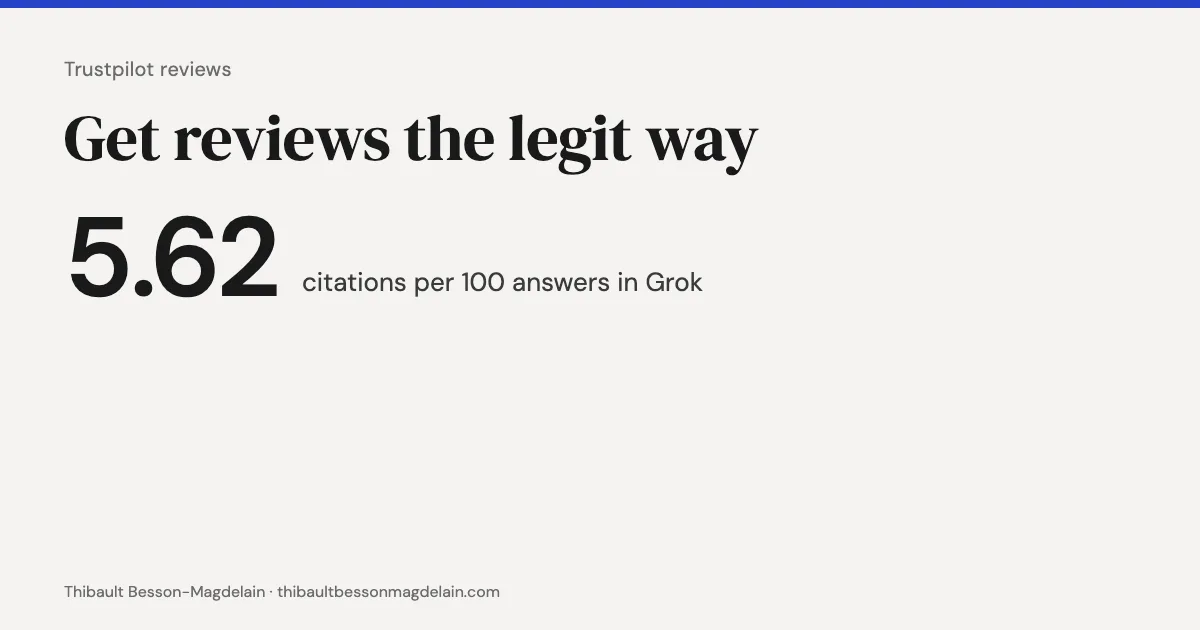
No. Grok cites Trustpilot 5.62 times per 100 answers and Gemini 3.93 times, while ChatGPT cites it 1.83 times, Perplexity 1.08 and Claude 0.80. If your buyers use Gemini or Grok, Trustpilot is one of your strongest levers; for Claude, directories matter more.
| AI | Trustpilot citations per 100 answers | Answers analyzed |
|---|---|---|
| Grok | 5.62 | 26,638 |
| Gemini | 3.93 | 148,287 |
| ChatGPT | 1.83 | 148,295 |
| Perplexity | 1.08 | 118,647 |
| Claude | 0.80 | 56,291 |
Industry changes the picture even more. Trustpilot is the first source cited in fashion (4.98 citations per 100 answers) and in arts and culture (3.20), and among the top 10 in logistics, electronics, gaming, travel and education. In software it ranks only 28th (0.81), and it does not appear in the top 50 sources for legal services, restaurants, finance or IT services, where official sites, TripAdvisor or specialized directories take over.
So before launching a review push, check that Trustpilot is a source the AIs actually use in your market. Sorank's Trustpilot AI citation study has the full breakdown, and the analysis of which sources AI cites covers the other platforms.
Should you reply to Trustpilot reviews?
Yes, to all of them, negative ones first and fast. A reply shows future customers how you handle problems, and it sits right under the review that an AI may quote.
For positive reviews, a short personal thank-you that mentions something specific is enough. For negative ones: acknowledge, give the facts without arguing, offer a concrete way to fix it, and move the details to a private channel. Never reveal personal data, never accuse the reviewer of lying in public. If a review clearly breaks the guidelines (fake, about another company, abusive), flag it, but Trustpilot is explicit that "not liking a star rating or disagreeing with a negative review is not a valid reason for flagging it". I go further in how to respond to negative reviews.
What happens if you buy or fake Trustpilot reviews?
They get removed, your profile can get a public warning, and in many countries you break consumer law. Trustpilot says that in 2024 it removed 4.5 million fake reviews, 7.4% of all reviews submitted, 90% of them automatically, out of 61 million reviews published that year.
Regulators are on the same line. In the US, the Federal Trade Commission's final rule of 14 August 2024 bans buying or selling fake reviews, including AI-generated ones, and incentives conditioned on a positive or negative review. In the EU, a screening coordinated by the European Commission found that at least 55% of 223 websites checked potentially broke consumer law on reviews. The risk is not worth it, especially since a fake review is precisely the kind of signal AI systems learn to discount.
So, how do you get Trustpilot reviews?
Invite every customer automatically, at the right moment, with a neutral message and a direct link, offer nothing in return, and reply to every review. Do it steadily rather than in bursts. Trustpilot is the website AIs cite most often behind business recommendations, so a real, active profile there now works for your Google reputation and your AI visibility at once.
To check whether ChatGPT, Gemini, Claude, Perplexity and Grok quote your Trustpilot page, track your AI mentions with Sorank (plans on the pricing page).
Sources
- Sorank Data, snapshot of 2 November 2026: Trustpilot citation figures by AI, month, language and industry.
- Trustpilot, "Guidelines for Businesses": invitations, incentives, self-reviews, flagging.
- Trustpilot, Trust Report 2025, 29 May 2025: 4.5 million fake reviews removed in 2024.
- US Federal Trade Commission, 14 August 2024: final rule banning fake reviews and review incentives.
- European Commission, press release IP/22/394, January 2022: screening of 223 websites.
FAQ
Can I offer a discount for a Trustpilot review?
No. Trustpilot's guidelines state that it does not allow incentivized reviews, whatever the incentive: discount, gift, refund or prize draw. In the US, the FTC rule of August 2024 also bans incentives conditioned on a positive or negative review.
Is Trustpilot free for businesses?
Trustpilot has a free plan that lets you claim your profile, reply to reviews and invite customers, and paid plans with more automation and features. Check Trustpilot's own business pages for the current limits, as they change.
Do Trustpilot reviews help SEO?
Indirectly. Your Trustpilot page can rank for searches on your brand name, and its rating shapes how people see you. In AI answers the effect is direct: Trustpilot is the most cited website across 498158 answers analyzed by Sorank, with 2.56 citations per 100 answers.
Founder of Sorank, the SEO and GEO platform that tracks how ChatGPT, Gemini, Perplexity, Claude and Grok talk about brands. Before Sorank, I ran an SEO agency that served more than 100 clients. Based in Budapest.
Read next
-
Online Reputation Management: Your Brand in Google and in AI
What Google and AI say about your brand, which sources they quote, and how to improve it.
-
How to Respond to Negative Reviews (With Templates)
A 5-part structure, 6 templates and the mistakes to avoid, with data on the review pages AI assistants cite.
-
How to Remove a Google Review: What Google Deletes and What Stays
What Google deletes, how to report and appeal, the legal route in the EU and US, and what to do with a review that stays.
Continue on reputation and AI visibility: all articles on the blog