How to Remove a Google Review: What Google Deletes and What Stays
You cannot delete a review from your profile, but Google removes reviews that break its rules, and the law covers the rest. Here is what works, step by step, and why the reviews that stay matter less than your other review pages.

Published · Updated · 9 min read
Contents
- Can you remove a Google review from your business profile?
- Which reviews does Google remove?
- How do you report a Google review, step by step?
- What legal options do you have in the EU and the US?
- Can you ask the customer to delete or update the review?
- Does a bad Google review hurt you in AI answers?
- What should you do with a negative review that stays?
- FAQ
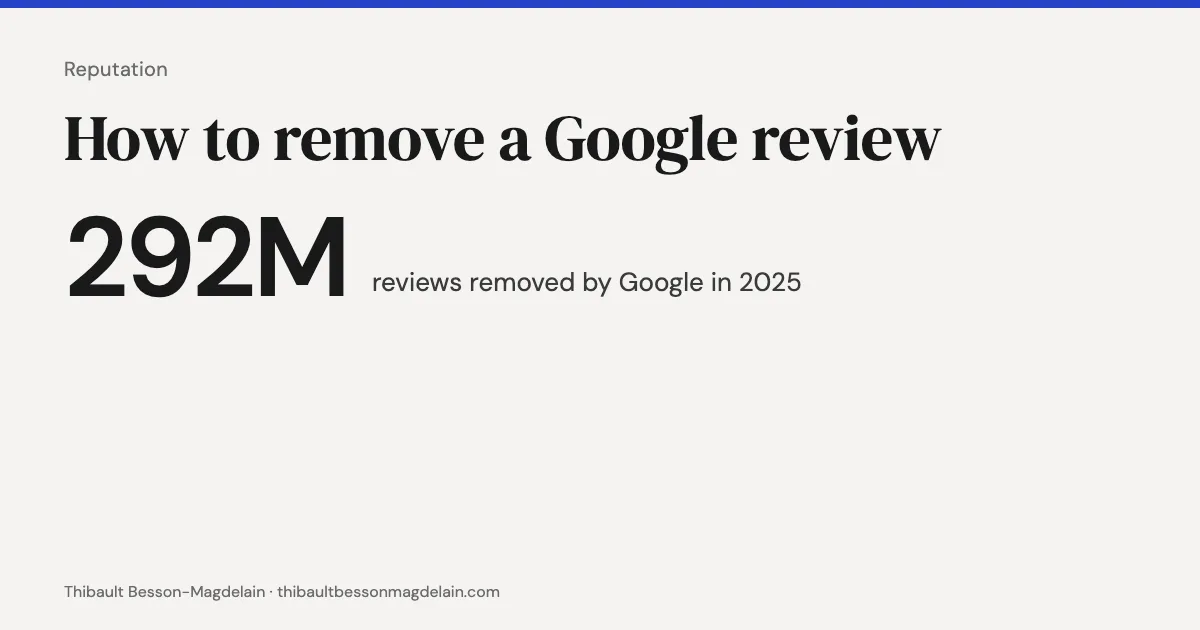
Remove a Google review: it is one of the first things business owners ask me after a bad week, and the honest answer is that you usually cannot, unless the review breaks Google's rules or the law. Google does remove a lot of content: according to Google's own Maps report, its systems and analysts blocked or removed over 292 million policy-violating reviews in 2025. But a genuine negative review, even an unfair one, stays.
This guide covers what Google removes, the exact reporting and appeal process, the legal routes in the European Union and the United States, and what to do with the reviews that stay. I ran an SEO agency with more than 100 clients before founding Sorank, and I now track which sources AI assistants cite about businesses, so I will also show why a single Google review matters less than you think and your other review pages matter more.
Can you remove a Google review from your business profile?
No, a business owner cannot delete a review directly. You can only report it, and Google removes it if it violates its prohibited and restricted content policy. The author can delete or edit their own review at any time, and a court can order removal of illegal content. Everything else stays online.
That rule protects you too: if owners could delete reviews, nobody would trust the stars, and the stars are why people click. Google also warns against reporting reviews just because you disagree with them. My view: flagging every critical review wastes time and credibility; flag only clear violations.
Which reviews does Google remove?
Google removes reviews that are fake, off-topic, promotional, written with a conflict of interest, harassing, hateful, sexually explicit, or that reveal personal information. A negative opinion from a real customer is not on that list, even if it is harsh, exaggerated or one-sided.
| Type of review | Removable by Google? | Best route |
|---|---|---|
| Fake review, bought review, rating manipulation | Yes (deceptive content) | Report in the Business Profile |
| Competitor or ex-employee (conflict of interest) | Yes, if Google can see it | Report, give context in the appeal |
| Review meant for another business | Yes (off-topic) | Report |
| Insults, hate speech, threats | Yes (harassment and abuse) | Report |
| Names, phone numbers, health details of a person | Yes (personal information) | Report |
| Defamatory accusation (crime, fraud) with no basis | Possibly, under the law | Google legal removal form, then a lawyer |
| Harsh but genuine negative opinion | No | Reply publicly, fix the cause |
| One star with no text from a real customer | No | Short reply asking for details |
A word of caution on "fake". From your side, a review from someone you do not recognize looks fake. From Google's side, it may be a real customer who used a nickname. The reports that work point to something Google can verify: a burst of one-star reviews in a few hours, an account that reviewed your three competitors positively the same day, a review describing a service you do not offer.
How do you report a Google review, step by step?
Report it from your Business Profile or from Google's Reviews Management Tool, choose the reason that matches the policy, and wait. Google says that "review evaluation typically takes several days". If the report is rejected, you can file a one-time appeal.
- From your Business Profile. Open your profile on Google Search or Maps, go to Reviews, click the report icon next to the review, pick the reason (spam, conflict of interest, profanity and so on) and send. The steps are on Google's "Report inappropriate reviews" help page.
- Track it in the Reviews Management Tool. Each report gets a status such as "Decision pending" or "Report reviewed, no policy violation". Google notes that merchants in the European Economic Area can also report third-party reviews directly on Google.
- Appeal once if needed. From the same tool, you can appeal up to 10 eligible reviews in one form. You receive the result by email. If the review is found compliant again, it stays.
- Keep evidence. Screenshots with the date, the reviewer's profile, your booking or sales records. You will need them for an appeal or a legal step.
Do not pay anyone who promises to "delete" reviews. Google's April 2026 update explicitly describes scammers who demand money from businesses:
Google says Maps now better identifies scam patterns, including "attempts to demand payment in exchange for removing fake one-star reviews."Bibek Samantaray, Group Product Manager, User Generated Content, Google, "New ways we're protecting businesses on Maps", 16 April 2026
The same post explains that when spam reviews suddenly spike, Maps removes the fake content, temporarily pauses new reviews on the profile, alerts the owner and shows a banner to consumers. If you are hit by a wave of fake reviews, report them and let that system work.
What legal options do you have in the EU and the US?
If a review is illegal (defamation, insult, false accusation of a crime, privacy breach), you can ask Google to remove it on legal grounds, then go to court against the author if needed. The rules differ by country, so treat this section as orientation and talk to a lawyer before acting.
- Google's legal form. Google's Report Content for Legal Reasons page is the entry point: "If you see content on a Google product that you believe violates the law or your rights, let us know." Google reviews the request and may block, limit or remove the content.
- European Union. The Digital Services Act (Regulation 2022/2065) requires hosting platforms to provide notice and action mechanisms for illegal content, to explain their decisions, and to offer an internal complaint system. If you disagree with the outcome, certified out-of-court dispute settlement bodies exist. Defamation itself remains defined by national law.
- United States. Section 230 of the Communications Decency Act largely shields platforms from liability for what users post, so a defamation claim usually targets the author, not Google. Be careful: the FTC's 2024 rule on fake reviews prohibits businesses from using unfounded legal threats or intimidation to remove negative reviews.
My view: the legal route is for real harm, like a false accusation of fraud that costs you clients. For a harsh but sincere opinion, a lawsuit almost always costs more than it brings, and it can turn one review into a news story.
Can you ask the customer to delete or update the review?
Yes, you can contact the customer, fix the problem, and politely ask whether they would like to update their review. What you cannot do is pay, threaten or condition a refund on the change. Only the author can edit or delete their review.
In practice, this works best with genuine customers whose problem you actually solved. Reply publicly first (the structure is in my guide on how to respond to negative reviews), solve the issue privately, then send one short message. If they say no, accept it. A visible, professional reply under a negative review often persuades the next reader more than a deleted review would have.
Does a bad Google review hurt you in AI answers?
A single Google review is rarely what an AI shows. In Sorank's data, AI assistants cite third-party review and consumer sites far more often than they link to Google: in English answers, Trustpilot gets 1.70 citations per 100 answers, ftc.gov 1.13 and bbb.org 0.54 (snapshot of 2 November 2026). Your reputation in AI answers is the sum of those pages.
That changes priorities. Spending weeks fighting one Google review while your Trustpilot page has no replies and your Better Business Bureau profile is incomplete is effort in the wrong place. Across all languages, Trustpilot is the most cited website in the whole dataset (2.56 citations per 100 answers out of 498,158), and it is cited 6.06 times per 100 answers by Grok and 4.31 by Gemini. The full breakdown by model and industry is on Sorank's data page.
To see what the AIs say about you, ask ChatGPT, Gemini and Perplexity "is [your company] reliable?" and "what do customers say about [your company]?", then note every link. If you want this every week across five AIs, that is what Sorank's AI visibility tracker does. For the bigger picture of how Google and AI present your brand, read my guides on the brand SERP and on online reputation management.
What should you do with a negative review that stays?
Reply to it well, fix its cause, and collect more genuine recent reviews so it becomes one voice among many. Buyers read the latest reviews and the owner's replies; a profile with 80 recent reviews and thoughtful answers absorbs a bad one without damage.
- Reply within 48 hours, calmly, in four to six sentences, with a direct contact.
- Fix the cause and mention the change in later replies.
- Ask every satisfied customer for a review, with a direct link, at the right moment (after delivery, after the service). Never buy reviews and never filter who you ask based on how happy they seem, which most platforms forbid.
- Watch the other platforms that matter in your market, not just Google.
So, can you remove a Google review?
You can remove a Google review only if it breaks Google's policies (fake, off-topic, conflict of interest, harassment, personal data) or the law; report it from your Business Profile, appeal once if needed, and use Google's legal form for defamation. Genuine negative reviews stay, so the real work is a good public reply, a fixed cause and a steady flow of new reviews. And keep perspective: AI assistants cite Trustpilot, consumer sites and directories far more often than a single Google review.
To see which review pages the AIs actually use when they talk about you, track your AI mentions with Sorank (plans on the pricing page).
Sources
- Google Business Profile Help, "Report inappropriate reviews on your Business Profile": reporting, statuses and appeal.
- Google Maps user contributed content policy, "Prohibited and restricted content": what Google removes.
- Google, "New ways we're protecting businesses on Maps", 16 April 2026: 292 million reviews removed in 2025, scam detection.
- Google Legal Help, "Report Content for Legal Reasons": the legal removal form.
- Regulation (EU) 2022/2065, Digital Services Act: notice and action, complaints, out-of-court settlement.
- FTC, final rule on fake reviews, 14 August 2024: ban on review suppression through threats.
- Sorank Data, snapshot of 2 November 2026: review sites cited by AI.
FAQ
Can I pay Google to remove a bad review?
No. Google does not sell review removal, and anyone who promises to delete reviews for a fee should be treated as a scam; Google's April 2026 update describes scammers who demand payment to remove fake one-star reviews. The only routes are reporting, appeal and the legal form.
How long does Google take to remove a reported review?
Google says review evaluation typically takes several days. You can follow the status in the Reviews Management Tool, and if the report is rejected you can file a one-time appeal, with the result sent by email.
Can I find out who wrote an anonymous Google review?
Not through Google directly. In most countries, identifying an anonymous author requires a court order addressed to the platform, which is only realistic for clearly illegal content such as defamation. Ask a lawyer before starting.
Founder of Sorank, the SEO and GEO platform that tracks how ChatGPT, Gemini, Perplexity, Claude and Grok talk about brands. Before Sorank, I ran an SEO agency that served more than 100 clients. Based in Budapest.
Read next
-
How to Respond to Negative Reviews (With Templates)
A 5-part structure, 6 templates and the mistakes to avoid, with data on the review pages AI assistants cite.
-
Brand SERP: What Google Shows for Your Brand and How to Control It
What Google shows for your brand name, how to control the knowledge panel, and how the same pages feed AI answers.
-
How to Get Trustpilot Reviews, the Legit Way, and Why AI Cares
Invite every customer, offer no incentive, reply, and why AI cites Trustpilot more than any site.
Continue on reputation and AI visibility: all articles on the blog