Brand SERP: What Google Shows for Your Brand and How to Control It
Your brand SERP is the first impression most prospects get, and the pages on it are the same ones AI assistants read about you. Here is what it contains, what you control, and how to improve it.

Published · Updated · 9 min read
Contents
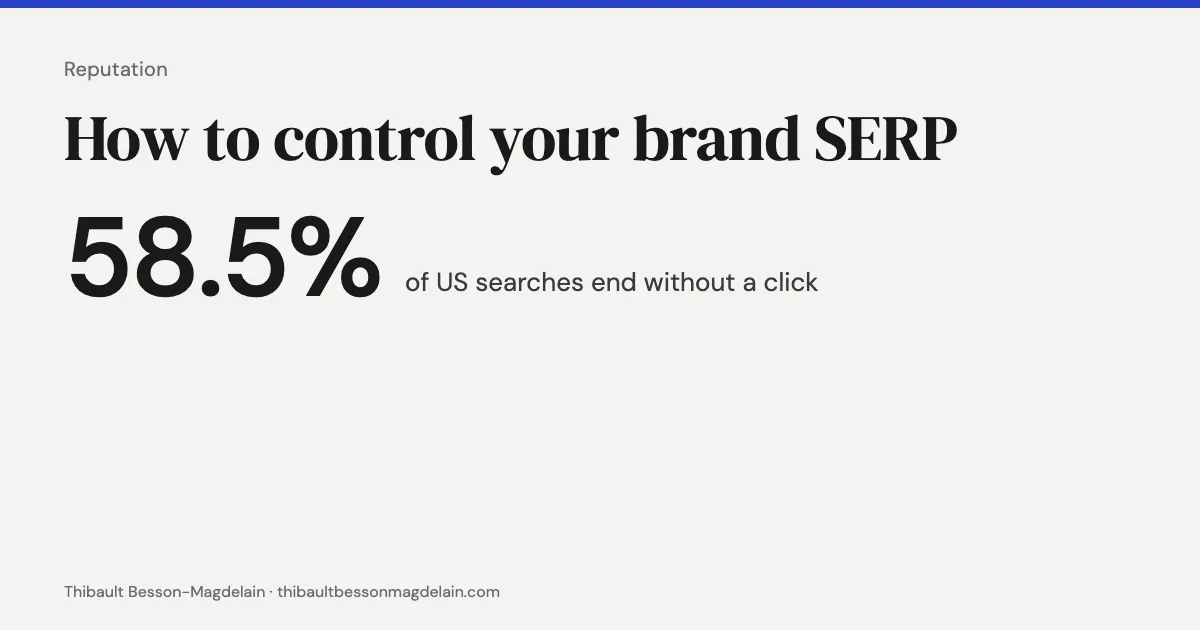
A brand SERP is the search engine results page that appears when someone types your brand name into Google. It is the page your prospects, journalists, investors and future hires see right before they decide whether to trust you, and most of them never click further: according to a 2024 SparkToro study based on Datos clickstream data, 58.5% of Google searches in the US end without a click (59.7% in the EU). What the results page shows is often the whole impression.
The term was popularized by Jason Barnard, who describes the brand SERP as your digital business card. I agree with the idea and I would add one thing: the same pages that fill your brand SERP are the ones AI assistants read when someone asks ChatGPT or Gemini about you. Before Sorank, I ran an SEO agency with more than 100 clients. Here is what it contains, what you can control, and how it connects to AI answers, with data from 498,158 AI responses.
What is a brand SERP?
A brand SERP is the set of results Google shows for a search of your exact brand name: your website and its sitelinks, your social profiles, review sites, videos, news, and often a knowledge panel on the right. It differs from a normal results page because the searcher already knows you. They are not choosing between competitors yet; they are checking you.
That makes it a high-stakes page. A clean brand SERP confirms what the visitor expected. A messy one (an old address, a two-star review site in third position, a namesake company, a forum thread about a dispute) creates doubt at the exact moment someone was ready to buy, call or sign.
What appears on a brand SERP?
Usually your official website with sitelinks in first place, then your main profiles (LinkedIn, YouTube, Facebook, Instagram), review sites, news articles, and for established brands a knowledge panel. The mix depends on how known the brand is, on the country and on what Google can confirm about you. You fully control only a few of these blocks.
| Element | Where it comes from | Your level of control | How to influence it |
|---|---|---|---|
| Official website | Your homepage | High | Clear title tag with the brand name, fast indexable homepage |
| Sitelinks | Your site's structure | Medium (automated) | Logical navigation, clear page titles, noindex to drop a page |
| Social profiles | LinkedIn, YouTube, Facebook, X, Instagram | High | Complete, active profiles with the exact brand name |
| Review sites | Trustpilot, Google reviews, sector platforms | Low to medium | Collect genuine reviews, reply to all of them |
| Knowledge panel | Google's Knowledge Graph | Low (automated) | Organization structured data, consistent facts, claim the panel |
| News and press | Media sites | Low | Publish data and stories worth covering |
| Wikipedia | Volunteer editors | None directly | Earn independent coverage; never write your own page |
My rule of thumb: aim to own or strongly influence the first six results. That means your site, two or three social profiles you keep alive, one review platform where you have many recent reviews, and one or two third-party pages that describe you accurately.
How do you get and control a knowledge panel?
You cannot create a knowledge panel: Google generates it automatically when it is confident enough about who you are. You can make that confidence easier to reach with consistent facts and structured data, and once a panel exists, you can claim it and suggest changes. Google says it plainly in its help center: "Knowledge panels are automatically generated", and the official representative of an entity can claim the panel.
- Publish Organization structured data on your homepage. This is the most direct signal you can send. Google's own documentation puts it this way:
"Adding organization structured data to your home page can help Google better understand your organization's administrative details and disambiguate your organization in search results."Google Search Central, Organization structured data
Include name, url, logo, description, founding date and sameAs links to your official profiles. Google adds that some properties "can influence visual elements in Search results (such as which logo is shown in Search results and your knowledge panel)". - Make the same facts match everywhere. Name, founding year, founders, address, description: identical on your site, LinkedIn, directories and press kit. Contradictions are what keep Google (and AI models) unsure.
- Claim the panel once it appears. Search your brand, click the option to claim the panel, verify with an official account, then use the feedback link to correct wrong facts.
- Earn independent mentions. Panels are fed by many web sources. Press coverage, directory listings and, for notable organizations, a Wikipedia article strengthen the signal.
For the markup side, my guide on schema markup for AI search has ready-to-adapt JSON-LD examples.
Why does your brand SERP matter for AI answers?
Because AI assistants build their answers about a brand from many of the same sources that fill its brand SERP. In Sorank's data (498,158 answers from five AIs, snapshot of 2 November 2026), Trustpilot is cited 2.56 times per 100 answers, Wikipedia 2.08 and YouTube 1.72, ahead of almost every other website. Fix those pages for Google and you fix them for the AIs at the same time.
The weights change a lot from one assistant to another. ChatGPT cites Wikipedia 5.40 times per 100 answers, Claude only 0.13. Gemini cites YouTube 4.01 times, ChatGPT 0.06. Grok leans on Trustpilot (5.62) and Facebook (1.58). So the "AI version" of your brand SERP depends on which assistant your buyer uses.
| Platform | ChatGPT | Gemini | Perplexity | Claude | Grok |
|---|---|---|---|---|---|
| Wikipedia | 5.40 | 1.49 | 0.12 | 0.13 | 0.46 |
| Trustpilot | 1.83 | 3.93 | 1.08 | 0.80 | 5.62 |
| YouTube | 0.06 | 4.01 | 2.30 | 0.03 | 0.72 |
| 0.42 | 1.01 | 0.73 | 0.16 | 1.05 | |
| 0.12 | 0.94 | 0.59 | 0.19 | 1.58 |
My take: treat the brand SERP and the AI answer as two views of the same file. The brand SERP is the one you can see instantly; the AI answer is the one you have to ask for. For a method to audit what AI says about you, read what ChatGPT says about your brand, and the full breakdown by model is on Sorank's data page.
How do you audit your brand SERP?
Search your exact brand name in a private window, on desktop and mobile, in each country you sell in, and record the first ten results and the side panel. Then score each result: do you own it, is it accurate, is it positive? It takes 30 minutes and gives you your to-do list.
- Search four variants. Brand name alone, brand + "reviews", brand + "avis" or your local equivalent, and the founder's name. Each one is a brand SERP that buyers really use.
- Note each result. URL, type (own, social, review, press, directory, other), sentiment (positive, neutral, negative), and accuracy (correct or outdated).
- Check the extras. Is there a knowledge panel, and is it correct? Sitelinks? "People also ask" questions about you? Those questions show what people doubt.
- Repeat in the AIs. Ask ChatGPT, Gemini and Perplexity "what is [brand]?" and "is [brand] reliable?", and note the links. You will often see the same Trustpilot, LinkedIn or Wikipedia pages.
- Repeat every month. Brand SERPs move with news, reviews and Google's changes.
How do you improve a brand SERP?
Strengthen the pages you control, feed the third-party pages Google and AI already trust, and give Google consistent facts. You do not push a bad result down by fighting it; you push it down by giving Google better results to show. Expect months, not days.
- Homepage title. Put the brand name first and say what you do: "Brand: what you do for whom".
- Sitelinks. Google's documentation says that "at the moment, sitelinks are automated". A clear menu, clear page titles and internal links to your key pages are what you can do; use noindex to drop a page you do not want there.
- Profiles you keep alive. Choose two or three networks and post regularly. A LinkedIn company page and a YouTube channel often rank on page one for a brand, and both are cited by AIs (LinkedIn 0.51, YouTube 1.72 citations per 100 answers).
- Reviews. Pick the review platform that matters in your market and build a steady flow of genuine reviews. Reply to the negative ones, calmly and quickly.
- Press and data. Original numbers get covered. Coverage creates third-party pages that rank for your name and that AIs can cite.
- A founder page. For small companies, the founder's name is a second brand SERP. Keep it consistent with the company's.
What can you do about a negative result on your brand SERP?
First check whether it breaks a rule or the law; if it does, request removal through the platform or Google's legal channels. If it does not, reply where you can, fix the cause, and build stronger pages that outrank it. Trying to hide a legitimate criticism usually makes it more visible.
For reviews specifically, the removal rules and the legal route are in my guide on how to remove a Google review. For the broader method, from Google to AI answers, see online reputation management.
So, what is a brand SERP and how do you control it?
A brand SERP is what Google shows for your brand name: your site, your profiles, review sites, press and often a knowledge panel; you control it by strengthening your own pages, keeping facts consistent with Organization structured data, claiming your knowledge panel and feeding the third-party pages Google already trusts. The same pages feed AI answers: Trustpilot, Wikipedia and YouTube are among the most cited sources in Sorank's 498,158 AI responses. Fix them once and you improve both.
To see the AI side of your brand SERP every week, across ChatGPT, Gemini, Perplexity, Claude and Grok, track your AI mentions with Sorank (plans on the pricing page).
Sources
- SparkToro, 2024 Zero-Click Search Study, 2 July 2024: 58.5% (US) and 59.7% (EU) of Google searches end without a click.
- Google Search Help, "About knowledge panels": automatic generation, claiming a panel.
- Google Search Central, Organization structured data: properties and purpose.
- Google Search Central, sitelinks: sitelinks are automated.
- Sorank Data, snapshot of 2 November 2026: platform citation rates per AI.
FAQ
How do I get a knowledge panel for my business?
You cannot request one: Google generates knowledge panels automatically when it is confident about an entity. Publish Organization structured data on your homepage, keep your name, description and key facts identical on your site and profiles, earn independent mentions, and claim the panel once it appears.
Can I remove a result from my brand SERP?
Only if it breaks the platform's rules or the law, or if it is your own page (delete it or add noindex). Otherwise, the way to push a result down is to give Google better results to rank: active profiles, review pages, press coverage and strong pages on your own site.
What is the difference between a brand SERP and a knowledge panel?
The brand SERP is the whole results page for your brand name. The knowledge panel is one block on it, usually on the right on desktop, built automatically from Google's Knowledge Graph.
Founder of Sorank, the SEO and GEO platform that tracks how ChatGPT, Gemini, Perplexity, Claude and Grok talk about brands. Before Sorank, I ran an SEO agency that served more than 100 clients. Based in Budapest.
Read next
-
How to Remove a Google Review: What Google Deletes and What Stays
What Google deletes, how to report and appeal, the legal route in the EU and US, and what to do with a review that stays.
-
How to Respond to Negative Reviews (With Templates)
A 5-part structure, 6 templates and the mistakes to avoid, with data on the review pages AI assistants cite.
-
How to Get Trustpilot Reviews, the Legit Way, and Why AI Cares
Invite every customer, offer no incentive, reply, and why AI cites Trustpilot more than any site.
Continue on reputation and AI visibility: all articles on the blog