AI Share of Voice: How to Measure It, With Real Data
Your share of the brands AI recommends is the new market share. Here is the formula, the traps in the denominator, and real data showing why one number for all AIs hides the story.

Published · Updated · 10 min read
Contents
- What is AI share of voice?
- How do you calculate AI share of voice?
- What does AI share of voice look like in real data?
- Which brands should you count in the denominator?
- Should you weight mentions by position in the answer?
- How often should you measure AI share of voice?
- How do you increase your AI share of voice?
- FAQ
AI share of voice is the percentage of brand mentions that go to your brand when AI assistants answer the questions your buyers ask, compared with your competitors. It is the closest thing to a market share of recommendations. And recommendations now happen inside the answer: 34% of US adults had used ChatGPT by early 2025, according to Pew Research Center, roughly double the 2023 share, and many of those conversations end with a shortlist of three or four companies.
I build Sorank, which asks ChatGPT, Gemini, Perplexity, Claude and Grok the same buyer questions every week. Its public dataset (498,158 answers, snapshot of 2 November 2026) lets me show something most guides skip: the same two brands can swap the lead depending on the AI. Below: the formula, a worked example from real data, the traps in the denominator, and how often to measure.
What is AI share of voice?
AI share of voice is your brand's mentions divided by all brand mentions in a fixed set of AI answers, times 100. If ChatGPT, Gemini and Perplexity name 200 companies across your 30 tracked questions and 40 of those mentions are you, your AI share of voice is 20%. It measures your weight in the conversation, not your traffic.
It differs from classic share of voice in advertising (your share of paid impressions) and from SEO share of voice (your share of estimated clicks on a keyword set). In AI answers there is no "position 1 to 10", no impression data and no click data from the platforms. What you can observe is who gets named, how often, where in the answer, and with which source. That is what the metric captures. Sorank's glossary has a short definition of AI share of voice if you need one for a report.
How do you calculate AI share of voice?
Count every brand named in each answer, then divide your count by the total. Do it per AI and per question group, then average. The formula is simple; the method is what makes it reliable.
AI share of voice = (your mentions / mentions of all tracked brands) x 100- Write a fixed question set. 20 to 50 real buyer questions, without your brand name: "best coworking in Lyon", "which concierge service for Airbnb in Nice". Keep them identical from month to month.
- Pick the AIs your buyers use. At least ChatGPT and Gemini, plus Perplexity, Claude and Grok if your market uses them. Record each AI separately.
- Run each question several times. Answers vary between runs, so one run is an anecdote. Three runs per question per AI is a minimum.
- Log every brand named, with its rank in the answer and the link given, if any.
- Compute per AI, then overall. One share per assistant, plus a weighted average by how much each AI matters to your buyers.
Two companion metrics stop you from misreading the number. Presence rate is the share of questions where you are named at all. Mention rate is your mentions per 100 answers, the unit Sorank's data uses. Share of voice can rise while presence falls, if competitors lose mentions faster than you. I always report the three together. If you want to try the arithmetic on your own counts, Sorank has a free AI share of voice calculator.
What does AI share of voice look like in real data?
Take two coworking brands in Sorank's real estate questions: Regus and WeWork. Head to head, Regus gets 43% of their combined mentions in ChatGPT, 48% in Gemini, 62% in Perplexity and 81% in Grok. Same brands, same questions, and the leader changes with the assistant.
Some context to read it honestly. Industry classification in the dataset starts in July 2026, so this covers July to October 2026. The real estate group holds 14,855 answers: 4,585 each for ChatGPT and Gemini, 3,485 for Perplexity, 1,650 for Claude and 550 for Grok. Grok's 93 against 22 rests on small counts, so treat its 81% as indicative. In Claude, Regus is named 2.97 times per 100 answers and WeWork does not reach Claude's top list, so I left Claude out of the chart.
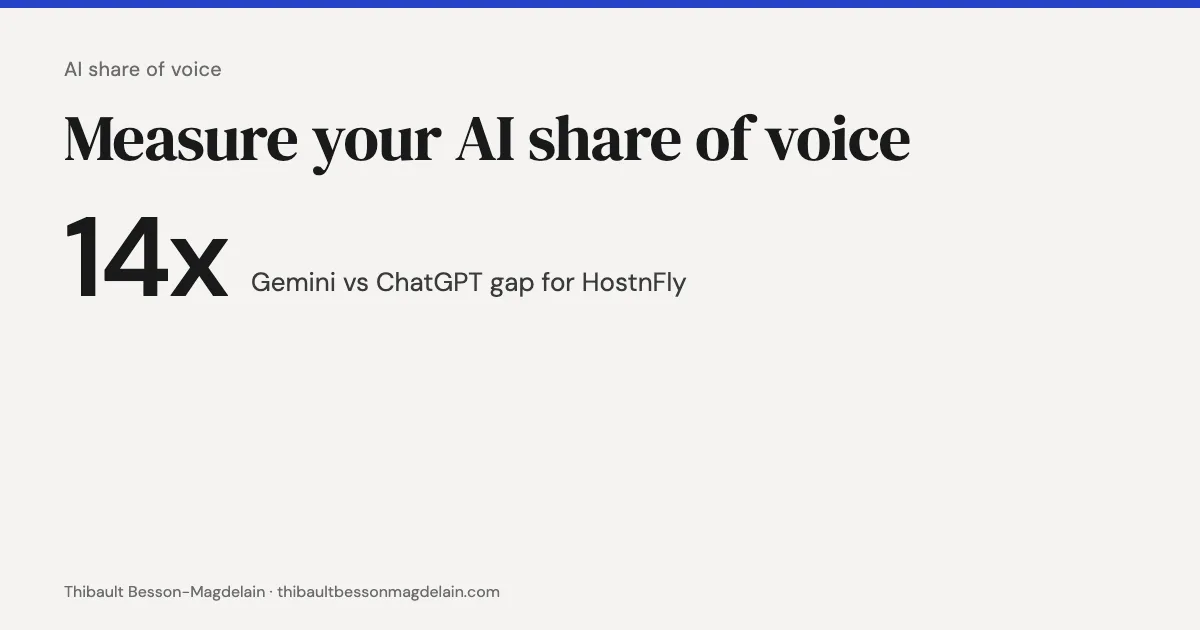
The second example is even sharper. HostnFly, a short-term rental management company, is the most named company of the whole real estate group (4.46 mentions per 100 answers overall). But that average hides a 14 times gap between assistants: 10.19 mentions per 100 answers in Gemini, 0.74 in ChatGPT.
My take: a single "AI share of voice" number for all assistants is almost useless. If HostnFly reported one average, it would miss that ChatGPT barely knows it. The decision to make (which sources to work on, which content to write) depends on which assistant is weak.
Which brands should you count in the denominator?
Count every brand the AI names in answers to your question set, not only the competitors you already know. A denominator limited to your three usual rivals inflates your share and hides the new names the AI is pushing.
In the real estate data, the top 10 companies overall mix four very different things: concierge services (HostnFly, GuestReady), coworking (Regus, WeWork), property diagnostics (MBDiag) and public bodies (service-public.fr). Put them in one denominator and you get a meaningless number: HostnFly would hold 16.8% of the top 10 mentions, but nobody compares a concierge service with a government site. The fix is to split your questions into buying intents and compute one share per intent.
| Metric | Formula | What it tells you | Main trap |
|---|---|---|---|
| Share of voice | Your mentions / all brand mentions | Your weight against competitors | Denominator too narrow or too mixed |
| Presence rate | Questions where you appear / all questions | How often you exist in answers | Ignores rank in the answer |
| Mention rate | Mentions per 100 answers | Absolute visibility, comparable over time | Moves with answer length |
| Position-weighted share | Mentions weighted by rank / total weighted | Whether you are first or an afterthought | Weights are a choice, keep them fixed |
| Citation share | Links to your domain / all links | Whether the AI uses your pages as proof | Many mentions come with no link |
Should you weight mentions by position in the answer?
Yes, if you can keep the weights fixed over time. Being named first in a list of five is worth more than being named fifth, and a simple weighting (for example 3 points for first, 2 for second, 1 for the rest) captures it. The Princeton researchers who defined GEO (optimization for generative engines) built their visibility metric on the same idea.
"Intuitively, sentences that appear first in the response are more likely to be read."Aggarwal et al., GEO: Generative Engine Optimization, KDD 2024
Their "position-adjusted word count" reduces the weight of a citation with its position in the answer (arXiv 2311.09735). You do not need their exact formula. You need a rule you apply the same way every month, so the trend means something.
How often should you measure AI share of voice?
Monthly at least, weekly if you can automate it. AI answers move fast, so a quarterly snapshot will show you a different world each time without telling you why.
The size of the moves is the reason. In the same Sorank panel, Wikipedia went from 11.31 citations per 100 answers in October 2025 to 0.12 in October 2026, and ChatGPT's total citations went from 728.59 per 100 answers in February 2026 to 213.45 in October 2026. When the sources an AI relies on shift that much, the brands it names shift too. Part of these moves come from the panel itself (more industries, more questions), which is one more reason to keep your own question set fixed.
By hand, a set of 30 questions times 5 AIs times 3 runs is 450 answers to read each month. That is fine once. It does not last. That is the job Sorank's AI mention tracking automates (plans on the pricing page). For an overview of the other ways to do it, see my comparison of AI visibility tools.
How do you increase your AI share of voice?
Work on the sources each AI cites for your questions, then on your own pages. AIs name the brands they can verify on third-party sites they already trust, so your share follows your presence on those sites.
- Find the weak assistant. Your share per AI tells you where to start, like ChatGPT for HostnFly.
- List the sources it cites. For each question, write down the domains behind the answers. My study of which sources AI cites shows that each AI has its own favorites: official sites and Wikipedia for ChatGPT, Trustpilot and YouTube for Gemini.
- Be present and accurate there. Complete profiles, recent reviews, the right category in directories, consistent facts about your company everywhere.
- Make your own pages quotable. Clear answers, comparison tables, prices and numbers with a source.
- Check what the AI says about you. A wrong fact repeated by ChatGPT costs you share. My guide on what ChatGPT says about your brand explains how to audit it.
Mentions often come without a click. Pew measured that users clicked a link inside Google's AI summaries in only 1% of visits where one appeared (Pew Research Center, July 2025). That is exactly why share of voice matters: it measures the influence that analytics will never see.
So, how do you measure AI share of voice?
Ask a fixed set of buyer questions to each AI several times, count every brand named, and divide your mentions by the total, per AI and per buying intent, every month. Add presence rate and a position weighting so the number cannot fool you. The real data shows why the split matters: Regus leads WeWork in Grok and Perplexity, and trails it in ChatGPT and Gemini.
If you want this measured for your brand without reading 450 answers a month, track your share of voice in five AIs with Sorank.
Sources
- Sorank Data, snapshot of 2 November 2026: Regus, WeWork and HostnFly mentions, citation trends.
- Sorank Data, methodology: sample, industry classification and limits.
- Aggarwal et al., "GEO: Generative Engine Optimization", KDD 2024: position-adjusted visibility metric.
- Pew Research Center, 25 June 2025: 34% of US adults have used ChatGPT.
- Pew Research Center, 22 July 2025: 1% of clicks on links inside AI summaries.
FAQ
What is a good AI share of voice?
There is no universal benchmark. Compare yourself with the leader of each buying intent: if the top brand holds 30% and you hold 10%, the gap is your target. Track the trend per AI rather than chasing an absolute number.
Is AI share of voice the same as SEO share of voice?
No. SEO share of voice estimates your share of clicks on a keyword set from rankings. AI share of voice counts how often assistants name your brand in their answers, with or without a click, and it varies a lot from one AI to another.
How many prompts do I need to measure AI share of voice?
Start with 20 to 50 real buyer questions grouped by intent, asked at least three times to each AI. Fewer questions make the number swing with every new answer; more questions are better if you can automate the collection.
Founder of Sorank, the SEO and GEO platform that tracks how ChatGPT, Gemini, Perplexity, Claude and Grok talk about brands. Before Sorank, I ran an SEO agency that served more than 100 clients. Based in Budapest.
Read next
-
How to Track AI Traffic in GA4: Channel Group and Regex
The exact GA4 setup to see traffic from ChatGPT, Perplexity, Claude and Gemini, and what Google Analytics cannot measure.
-
Schema Markup for AI Search: Which Types Matter and Why
What Google and Microsoft say about schema for AI, the 4 types that matter, and JSON-LD you can ship.
-
Robots.txt for AI Crawlers: Which Bots to Allow and Block
What each AI crawler does (GPTBot, OAI-SearchBot, ClaudeBot, Google-Extended), which to allow, and a robots.txt to copy.
Continue on AI visibility: all articles on the blog