AI Search in Healthcare: Which Sources AI Trusts for Care
Health is the most sensitive topic an AI can answer, and it shows in the sources. I analyzed 7,125 AI answers about care providers to see who gets cited. Public health authorities come first, but the surprise is how often clinics' own websites are quoted.
Published · Updated · 10 min read
Contents
- How does AI search answer healthcare questions?
- Which sources does AI cite for healthcare?
- Can a clinic's own website get cited?
- Does each AI trust the same health sources?
- Why is healthcare treated differently by AI and Google?
- How do you make a practice visible in AI answers?
- What about English-language answers?
- What are the limits of this data?
- FAQ
AI search in healthcare has moved from novelty to habit. According to the Pew Research Center, about two in ten (22%) Americans get health information from AI chatbots at least sometimes. Patients ask "where can I get orthodontic aligners in Charleroi" or "which center treats head lice quickly", and the AI answers with a few names, a few rules and a few links. For a clinic or a practice, the question is simple: which sources does the AI trust enough to quote?
I build Sorank, a platform that asks the same patient and buyer questions to ChatGPT, Gemini, Perplexity, Claude and Grok every week. Its public AI citation study for healthcare holds 7,125 answers about care providers, collected between July and October 2026. All the figures below come from the snapshot of 2 November 2026. One important note before reading: an AI answer is not medical advice, and nothing here is either. This is about visibility, not about care.
How does AI search answer healthcare questions?
On healthcare questions, an AI first leans on public health authorities to frame the answer (coverage, reimbursement, official guidance), then names care providers whose own pages describe their services clearly. It cites fewer links than in other industries, and it favors sources that are official or directly responsible for the care.
The numbers show that caution. A healthcare answer carries on average 2.71 citations with ChatGPT, 1.72 with Perplexity, 2.28 with Claude and 6.33 with Gemini. That is lower than in software or construction for every model. Big general platforms also matter less here: Wikipedia is almost absent (0.00 citations per 100 answers in October 2026) and Trustpilot gets 0.41.
Which sources does AI cite for healthcare?
The most cited source is ameli.fr, the French national health insurance site, with 11.58 citations per 100 answers. Behind it, the list is dominated by care providers: lice treatment centers (zoulespoux.com 4.74, institut-antipoux.fr 4.08), medical centers in Charleroi (espace-sante-charleroi.be 4.67), a hospital group (ghdc.be 3.90) and dental clinics (dentius.be 3.02). The Belgian federal health portal (health.belgium.be, 3.49) and the Belgian health insurance institute (inami.fgov.be, 2.01) complete the official layer.
| Type of source | Examples in the data | Citations per 100 answers | Why the AI uses it |
|---|---|---|---|
| Public health authority | ameli.fr, health.belgium.be, inami.fgov.be | 11.58 / 3.49 / 2.01 | Coverage, reimbursement, official rules |
| Care provider's own site | espace-sante-charleroi.be, ghdc.be, dentius.be | 4.67 / 3.90 / 3.02 | Services, location, team, how to book |
| Booking platform | doctoranytime.be, doctolib.fr | 2.27 / 2.25 | Availability and practitioner lists |
| Product brand | invisalign.fr | 2.67 | Treatment description, provider locator |
| Medical reference | vidal.fr, clevelandclinic.org | 1.59 / 1.22 | Explaining a condition or a treatment |
| Review platform | Trustpilot | 0.41 | Rarely used for care |
Can a clinic's own website get cited?
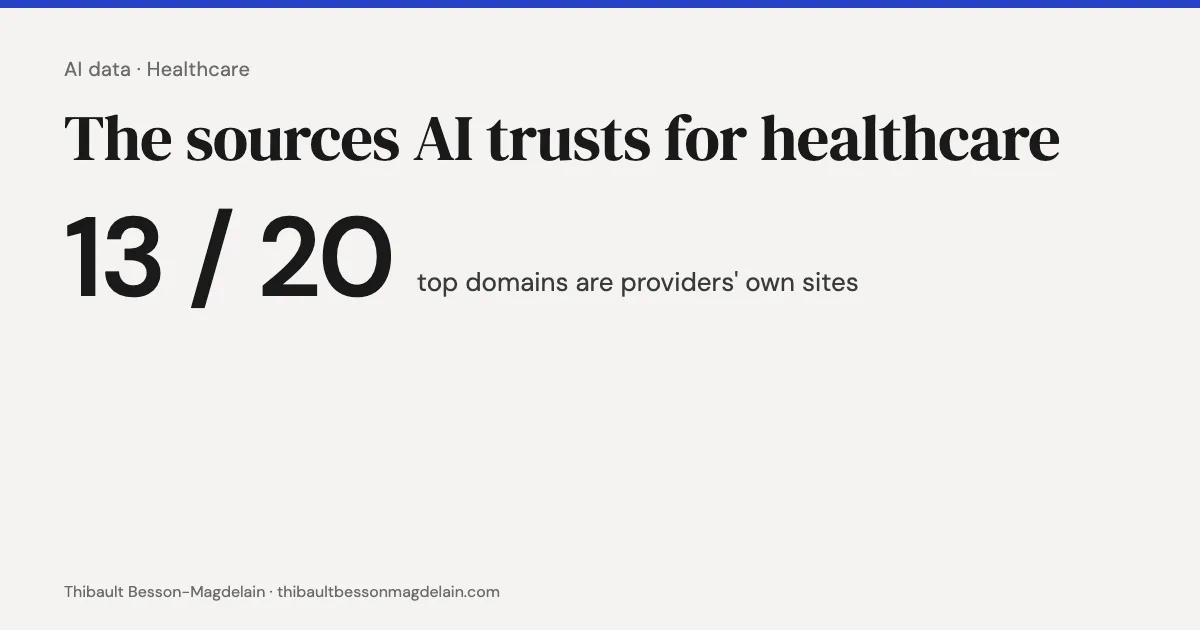
Yes, more than in almost any other industry. 13 of the 20 most cited domains are care providers' own websites: medical centers, dental clinics, a hospital group, specialized practices. In most sectors, AI quotes what directories and review platforms say about a business. In health, it quotes the provider, as long as the page explains clearly what is done, where and by whom.
My reading: patients ask practical questions ("does this center take walk-ins", "is this treatment covered", "which dentist does aligners near me"), and reviews are a weak, sometimes risky signal for medical quality. So the AI goes to the source of the care. A provider page that answers those questions in plain text has a real chance of being the link shown. A page that says "welcome to our practice" and a phone number has none.
Does each AI trust the same health sources?
No. ChatGPT cites ameli.fr 28.96 times per 100 answers and no booking platform; Gemini cites ameli.fr 9.69 times and the booking platforms Doctolib (7.66) and Doctoranytime (6.75). Claude and Perplexity go straight to providers' own sites.
- ChatGPT is the authority camp: ameli.fr, health.belgium.be (7.86), inami.fgov.be (6.22), the French health authority HAS (has-sante.fr, 4.72), plus medical references like Cleveland Clinic (6.55), the NIH's PubMed Central (4.00) and the NHS (3.47).
- Gemini mixes the official site with clinics and booking platforms: espace-sante-charleroi.be (9.30), invisalign.fr (7.76), Doctolib, Doctoranytime. It cites the most links per answer (6.33).
- Claude cites providers almost exclusively: dental clinics, a lice treatment practice, regional health sites, and psychologue.net (3.33), a therapist directory.
- Perplexity cites local medical centers and the city of Charleroi's site (2.51), with very few links per answer (1.72).
- Grok has 450 answers and its list is made almost entirely of lice treatment centers (institut-antipoux.fr 28.00), which likely reflects the questions more than a general habit. Indicative only.
Why is healthcare treated differently by AI and Google?
Because health is a "Your Money or Your Life" topic, where a bad answer can hurt someone. Search engines and AI models apply a higher bar of trust, which favors official sources and providers who are accountable for the care. Google states it directly in its guidance on helpful content, after listing experience, expertise, authoritativeness and trustworthiness:
"Of these aspects, trust is most important."Google Search Central, Creating helpful, reliable, people-first content
The same page explains that its systems give even more weight to trust "for topics that could significantly impact the health, financial stability, or safety of people", which Google calls "Your Money or Your Life" topics (source).
For a practice, this has two consequences. First, you will not outrank the national health insurance site on coverage questions, and you should not try: link to it and explain how it applies to your patients. Second, trust signals on your own pages (who the practitioners are, their qualifications, registration numbers, what the center does and does not do) are exactly what a cautious model looks for before naming you. In many countries, health professionals' communication is also regulated, so factual and verifiable beats promotional on both counts.
How do you make a practice visible in AI answers?
You make a practice visible by publishing clear, factual pages about each service, each location and each practitioner, keeping your booking and directory listings complete, and linking to the official sources that frame your care. Here is the order I would follow.
- One page per service. "Aligner treatment", "pediatric dentistry", "lice treatment for children": what it is, who it is for, how long it takes, whether it is reimbursed, how to book. Written for patients, in plain text.
- One page per location and per practitioner. Name, qualifications, registration, languages spoken, opening hours, access. These are the facts a model can verify.
- Complete booking platform profiles. Gemini cites Doctolib 7.66 times and Doctoranytime 6.75 times per 100 answers. An empty or outdated profile is a missed citation.
- Link to the official sources. When you explain reimbursement, link to the health insurance page. ChatGPT trusts those sources; showing that your page agrees with them helps.
- Structured data for the practice. MedicalClinic, Dentist or Physician types in schema.org, with address and hours, help machines read the basics. I explain the method in my guide to schema markup for AI search.
- Facts over claims. The Princeton researchers who named generative engine optimization found that adding statistics and quotations from reliable sources can raise a page's visibility in AI answers by up to 40% (Aggarwal et al., KDD 2024). In health, "the best clinic in town" is both useless to a model and often not allowed.
For the specifics of each sector, the Sorank page for medical clinics and the one for dentists show what the tracking looks like (plans on the pricing page). To understand why ChatGPT behaves so differently from Gemini, read what sources ChatGPT uses, and for the cross-industry picture, which sources AI cites.
What about English-language answers?
The English sample is smaller (1,125 answers) and very different. Cleveland Clinic leads with 13.60 citations per 100 answers, followed by consumer oral care brands and the American Academy of Family Physicians (aafp.org, 6.49) and Mayo Clinic Health System (5.33). The pattern is the same as in French: large medical institutions and official references frame the answer, then specific providers or products are named.
If you run a practice in an English-speaking market, your "ameli.fr" is the NHS, your national insurer or your professional body, and your "Doctolib" is the booking platform patients use locally. Check which ones the AIs cite for your specialty before investing.
What are the limits of this data?
- Topic mix. The panel reflects the questions tracked for Sorank clients: dental care, medical centers, lice treatment, orthodontics. Some leaders (lice centers) come from that mix.
- Geography. 6,000 answers in French, heavily Belgian (Charleroi, Brussels) and French, and 1,125 in English.
- Period and samples. July to October 2026. ChatGPT and Gemini 2,075 answers each, Perplexity 1,475, Claude 1,050, Grok 450.
- Unit. Citations per 100 answers, not a share of answers.
So, how does AI search work in healthcare?
In healthcare, AI search frames its answers with public health authorities (ameli.fr gets 11.58 citations per 100 answers, 28.96 with ChatGPT) and then quotes care providers' own websites, which make up 13 of the 20 most cited domains. Booking platforms matter for Gemini, review platforms barely count. A practice that explains each service, location and practitioner clearly, and keeps its booking profiles complete, gives the AIs what they need to name it.
To see what the five AIs say about care in your area today, start tracking your AI mentions with Sorank.
Sources
- Sorank Data, AI citation study: healthcare, snapshot of 2 November 2026: every healthcare figure in this article.
- Pew Research Center, 7 April 2026: 22% of US adults get health information from AI chatbots at least sometimes.
- Google Search Central, "Creating helpful, reliable, people-first content": trust and YMYL topics.
- Aggarwal et al., "GEO: Generative Engine Optimization", KDD 2024: up to 40% visibility gain.
FAQ
Where does ChatGPT get its medical information from?
On questions about care providers, ChatGPT relies mostly on official and institutional sources: ameli.fr (28.96 citations per 100 answers in this dataset), the Belgian health portal (7.86), Cleveland Clinic (6.55), the Belgian health insurance institute (6.22), the French health authority HAS (4.72) and PubMed Central (4.00). It cites booking platforms and review sites very little.
How can a clinic appear in AI search results?
Publish one clear page per service, location and practitioner, with qualifications, hours and how to book in plain text; keep booking platform profiles complete; and link to official sources when you explain coverage. In this dataset, 13 of the 20 most cited healthcare domains are providers' own websites.
Is it safe to use AI search for health questions?
AI answers can help you understand options and find providers, but they are not medical advice. In this dataset, the AIs lean on official health authorities for rules and coverage, which is reassuring, but always confirm a diagnosis or treatment with a qualified professional.
Founder of Sorank, the SEO and GEO platform that tracks how ChatGPT, Gemini, Perplexity, Claude and Grok talk about brands. Before Sorank, I ran an SEO agency that served more than 100 clients. Based in Budapest.
Read next
-
AI Search for Contractors: Where AI Finds Builders and Trades
To recommend contractors, ChatGPT cites government sites while Gemini and Claude rely on business directories.
-
AI Search in Finance and Insurance: Regulators Come First
In finance and insurance, ChatGPT cites regulators while Gemini, Claude and Perplexity cite comparison sites.
-
AI Search for SaaS: Your Own Website Beats G2
Across 26,668 AI answers about software, vendors' own sites are cited far more than G2, and Capterra is absent.
Continue on AI visibility: all articles on the blog