Wikipedia LLM Citations: How ChatGPT Dropped Its Favorite Source
Over the full period, Wikipedia is the third most cited website in AI answers about businesses. Almost all of that comes from ChatGPT, which cited it about once for every two answers in late 2025, and then, in April 2026, practically stopped.

Published · Updated · 9 min read
Contents
- How often do LLMs cite Wikipedia?
- Which AI models cite Wikipedia?
- Why did Wikipedia citations collapse in 2026?
- Do English and French answers cite Wikipedia the same way?
- Does Wikipedia still matter for AI visibility?
- What can a brand do, and not do, on Wikipedia?
- Is Wikidata a better option for a company?
- So, do LLMs still cite Wikipedia?
- FAQ
Wikipedia LLM citations used to be the safest bet in AI visibility: the encyclopedia was everywhere in ChatGPT's answers. The Wikimedia Foundation itself notes that human pageviews on Wikipedia fell by roughly 8% year on year in 2025, as search engines answer more questions directly. My data shows a second, sharper shift on the citation side.
I run Sorank, which asks the same buyer questions to ChatGPT, Gemini, Perplexity, Claude and Grok every week and records every link they give. The public dataset covers 498,158 answers from August 2025 to October 2026, and the Wikipedia curve is detailed in the Wikipedia decline study on sorank.com/data (snapshot of 2 November 2026). Here is what happened, and what a brand can still do about Wikipedia and Wikidata.
How often do LLMs cite Wikipedia?
Over the full period, a lot. Wikipedia gets 2.08 citations per 100 answers (10,381 citations) and ranks 3rd among all cited domains, behind Trustpilot (2.56) and service-public.gouv.fr (2.36). But that average mixes two very different eras: before April 2026, and after.
On business questions, an AI cites Wikipedia for context: the definition of a profession, the history of a brand, the rules of a market. It is rarely the page that recommends a provider, but it is often the page that explains the category the provider belongs to. For a company with its own article, it can also be the page that confirms who the company is.
Which AI models cite Wikipedia?
Mainly ChatGPT. ChatGPT cites Wikipedia 5.40 times per 100 answers, Gemini 1.49, Grok 0.46, Claude 0.13 and Perplexity 0.12. In ChatGPT's own ranking of sources, Wikipedia is second, just behind service-public.gouv.fr. For the other models it is a minor source.
The contrast between ChatGPT and Perplexity is striking: ChatGPT cited Wikipedia 45 times more often. Perplexity prefers YouTube and review sites, Claude prefers directories. If your buyers use Perplexity or Claude, a Wikipedia article about your company has very little direct weight in the answers they see. My breakdown of ChatGPT's other sources is in what sources ChatGPT uses.
Why did Wikipedia citations collapse in 2026?
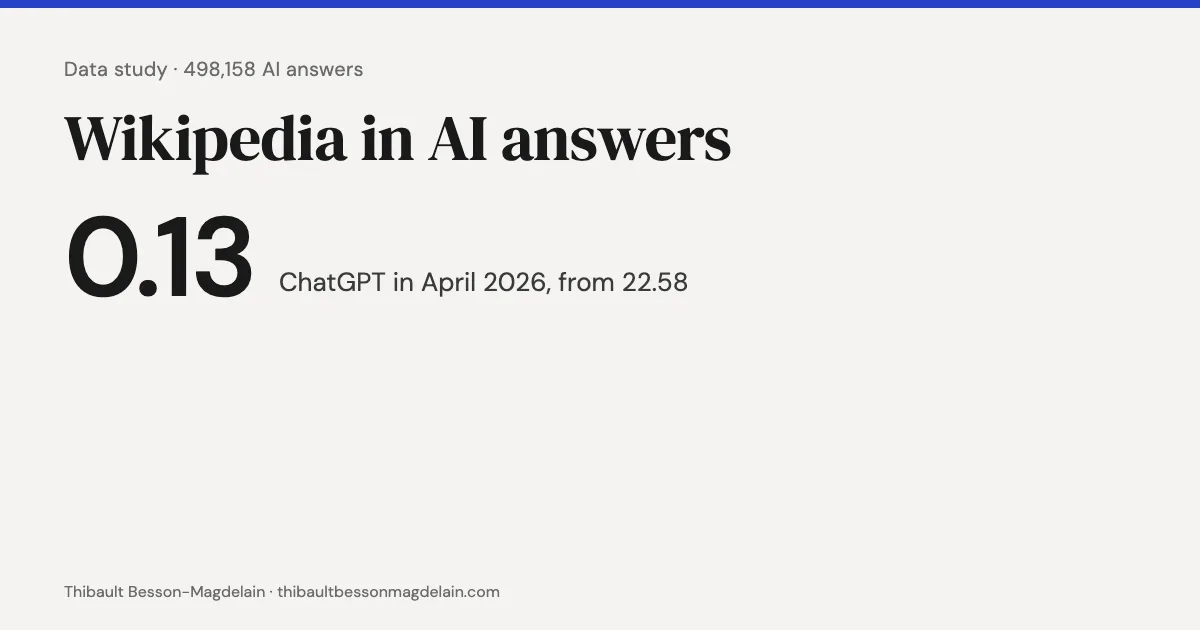
Because ChatGPT stopped citing it, almost overnight. ChatGPT went from 22.58 Wikipedia citations per 100 answers in March 2026 to 0.13 in April 2026, on samples of 6,958 and 5,295 answers. It had peaked at 47.26 in October 2025, about one Wikipedia citation for every two answers.
After April, ChatGPT stayed near zero, with a short return in July 2026 (4.28) and August 2026 (3.35), then 0.09 in September and 0.04 in October 2026 on 33,829 answers. Gemini followed a similar path later: 6.83 in June 2026, 0.17 in October 2026. All models combined, Wikipedia fell from 11.31 in October 2025 to 0.12 in October 2026.
The data shows when it happened, not why. The drop is too abrupt and too large to come from the panel alone: the March and April samples were similar in size (6,958 and 5,295 ChatGPT answers), and the value went from 22.58 to almost zero in one month. It looks like a change in how ChatGPT selects and displays its sources. My opinion: never treat one source as permanent, even one as established as Wikipedia. I track these shifts across platforms in AI citation trends.
Do English and French answers cite Wikipedia the same way?
No, French answers cite it more than twice as often. Wikipedia gets 2.26 citations per 100 French answers (3rd) and 0.93 per 100 English answers (9th). ChatGPT drives both: 5.89 in French, 2.27 in English.
| Measure | French answers | English answers |
|---|---|---|
| All models | 2.26 (3rd) | 0.93 (9th) |
| ChatGPT | 5.89 (2nd) | 2.27 (3rd) |
| Gemini | 1.57 (9th) | outside top 30 |
| Answers analyzed | 435,183 | 59,825 |
Part of the gap comes from timing: 96% of the English answers in the panel were collected from July 2026 onwards, after ChatGPT's change, while French answers cover the whole period. So the honest reading is not "English AI ignores Wikipedia" but "the English sample mostly saw the post-April world".
Does Wikipedia still matter for AI visibility?
Less as a cited link, still as background knowledge. As a visible source in AI answers, Wikipedia now weighs almost nothing (0.12 per 100 answers in October 2026). But models learn from it, and the Wikimedia Foundation says so plainly:
"Almost all large language models (LLMs) train on Wikipedia datasets."Marshall Miller, Wikimedia Foundation, "New User Trends on Wikipedia", 17 October 2025
So a Wikipedia article still shapes what a model "knows" about your company, your founders and your category, even when the answer does not link to it. The difference is that you will not see it in the sources, which makes it hard to measure. My view: if your company already has an article, keeping it accurate is cheap insurance. If it does not, chasing one for AI visibility is a poor use of time compared with review platforms and directories, which are cited every day.
What can a brand do, and not do, on Wikipedia?
A brand can earn notability and request corrections; it cannot write its own article or pay someone to do it without disclosure. Wikipedia's rules on company notability and conflicts of interest are explicit.
| Action | Allowed? | What the rules say |
|---|---|---|
| Writing your own company article | Strongly discouraged | Editors with a conflict of interest should propose changes, not edit directly |
| Paying an agency to edit | Only with disclosure | "Paid editing must be disclosed" |
| Asking for a factual correction | Yes | Post a suggested edit on the article's talk page, with a source |
| Getting an article because you exist | No | Needs significant coverage in independent, reliable sources |
| Creating a Wikidata item | Yes, if criteria are met | A clearly identifiable entity backed by serious public references |
The practical path is boring and effective: get covered by real media, trade press and books for what you actually do. Once independent sources exist, the encyclopedia follows, written by someone else. If your article exists and contains an error, use the talk page with a reliable source; editing it yourself without disclosure usually ends with a reverted edit and a damaged reputation.
Is Wikidata a better option for a company?
Often, yes. Wikidata is the structured database behind Wikipedia, and its bar is lower: an item needs to describe a clearly identifiable entity backed by serious, publicly available references, or to serve a structural need, according to the Wikidata notability policy. A company registered in an official register and covered by a few credible sources can often qualify.
A clean Wikidata item gives machines unambiguous facts: legal name, founding date, headquarters, website, founders, official social profiles. It does not show up as a link in AI answers in my data, but it helps any system that resolves "which company is this?". Pair it with consistent structured data on your own site, which I cover in schema markup for AI search, and with consistent profiles everywhere AI does cite: review platforms, directories, LinkedIn.
- Check whether an item exists for your company on wikidata.org, and whether its facts are right.
- Add references to each statement: an official register, a press article, your site for basic facts.
- Keep names identical across Wikidata, your site, your review profiles and your directories.
- Measure where you are actually cited. Since Wikipedia barely appears as a source anymore, track which sources do: the ChatGPT rank tracker or the full AI mention tracking show them week by week.
So, do LLMs still cite Wikipedia?
Barely: Wikipedia is the 3rd most cited website over the whole period (2.08 citations per 100 answers), but that came almost entirely from ChatGPT, which dropped it from 22.58 in March 2026 to 0.13 in April 2026 and 0.04 in October 2026. Models still learn from Wikipedia, so an accurate article helps in the background, but it is no longer a visible source you can count on. A company's effort is better spent on independent coverage, a clean Wikidata item and the sources AI cites today.
To see which sources replaced Wikipedia in your market, check the five AIs every month. See Sorank plans.
Sources
- Sorank Data, "The websites AI cites most", snapshot of 2 November 2026: every citation figure in this article.
- Sorank Data, Wikipedia in AI answers: a study of its decline over 13 months: the monthly curve.
- Marshall Miller, Wikimedia Foundation, "New User Trends on Wikipedia", 17 October 2025: human pageviews down about 8%, and the quote on LLM training.
- Wikipedia, "Notability (organizations and companies)": the bar for a company article.
- Wikipedia, "Conflict of interest": paid editing must be disclosed, changes go through talk pages.
- Wikidata, "Notability": the criteria for a Wikidata item.
FAQ
Does ChatGPT use Wikipedia?
It used to, massively: 47.26 citations per 100 business answers in October 2025 in Sorank's dataset. Since April 2026 it has almost stopped citing Wikipedia as a source, with 0.04 per 100 answers in October 2026 (snapshot of 2 November 2026). Wikipedia remains part of the data most LLMs are trained on.
Can I create a Wikipedia page for my company?
Only if independent, reliable sources have already covered your company in depth. Wikipedia asks people with a conflict of interest not to write about themselves directly and to disclose any paid editing. In practice, earn the press coverage first; if the company is notable, an independent editor can write the article.
Which AI cites Wikipedia the most?
ChatGPT, with 5.40 citations per 100 answers over the whole period, against 1.49 for Gemini, 0.46 for Grok, 0.13 for Claude and 0.12 for Perplexity. Almost all of ChatGPT's Wikipedia citations date from before April 2026.
Founder of Sorank, the SEO and GEO platform that tracks how ChatGPT, Gemini, Perplexity, Claude and Grok talk about brands. Before Sorank, I ran an SEO agency that served more than 100 clients. Based in Budapest.
Read next
-
YouTube AI Citations: Which AIs Quote Videos, and How to Get Cited
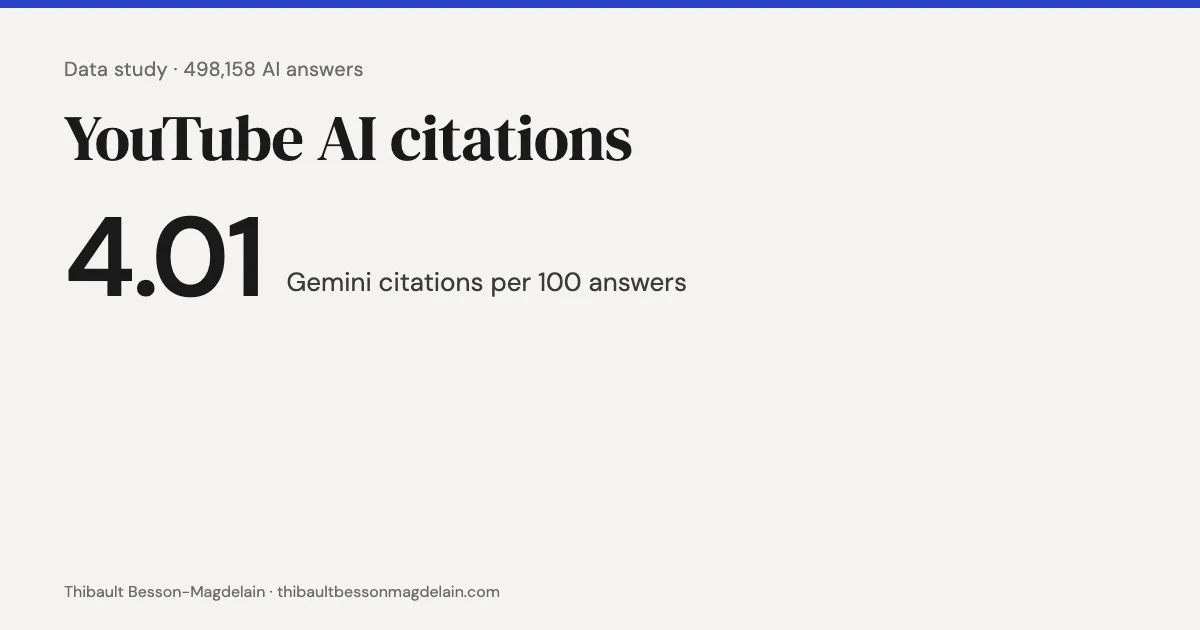
Gemini cites YouTube 4.01 times per 100 answers, ChatGPT 0.06: which AIs quote videos, and how to get yours cited.
-
LinkedIn AI Visibility: When AI Cites LinkedIn, and What Founders Should Do
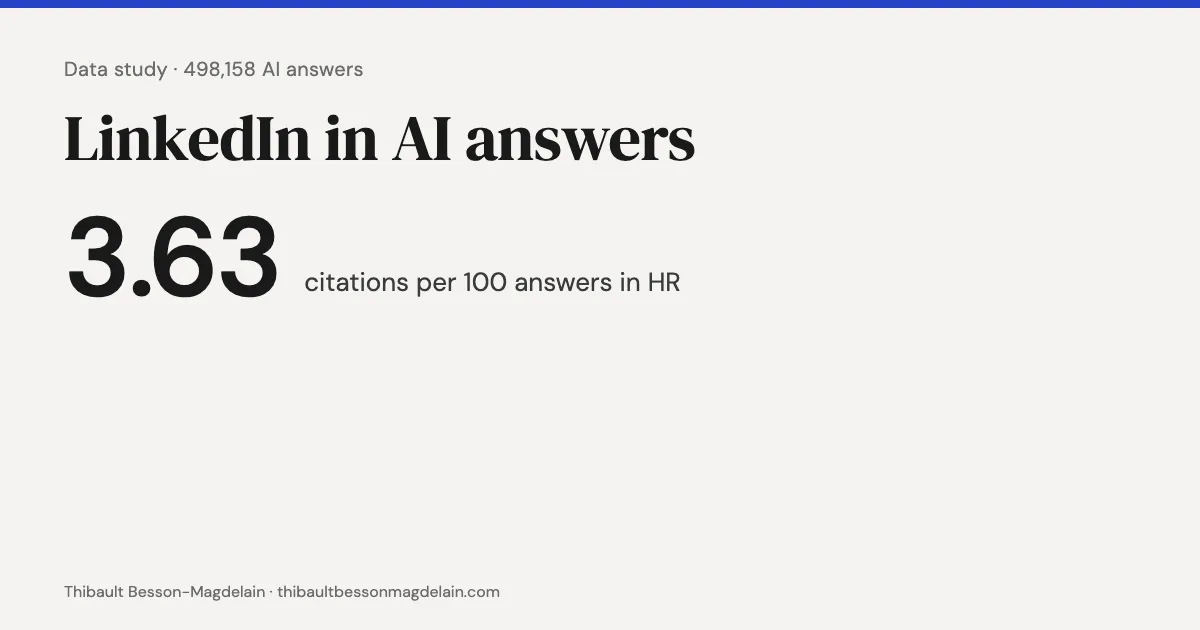
LinkedIn gets 0.51 citations per 100 AI answers, but 3.63 in HR: when it matters and what founders should do.
-
Reddit AI Citations: What 498,158 Answers Really Show
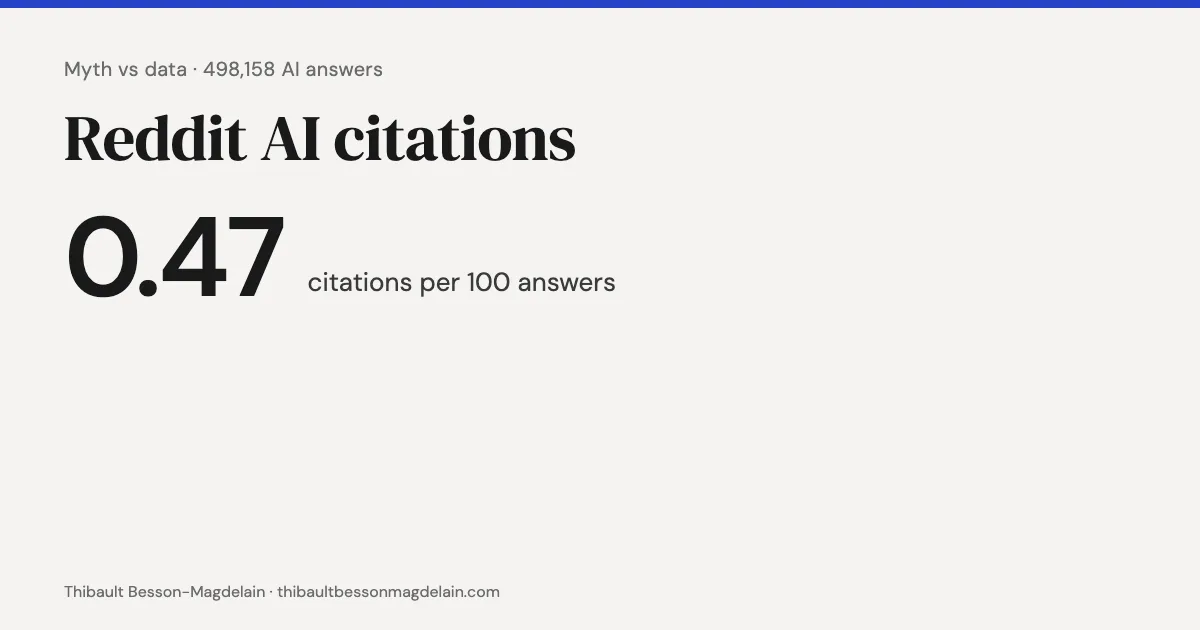
Reddit gets only 0.47 citations per 100 AI answers on business questions, and Claude never cites it.
Continue on AI visibility: all articles on the blog